MC-ing for Napa Valley Film Festival

Since meeting Dania Denise on the set of a local TV news show that was covering our respective stories, we occasionally collaborate as volunteers for the non-profits we each support. For Dania, I manned the journalism post at a career exploration event for Citizen Schools students. Next, Dania and her Think Post Productions partner Rob Carrera joined me for a WeXL panel discussion hosted by the organization’s founder, Arabella DeLucco.

The David/Dania collaboration culminated at the Napa Valley Film Festival, November 7-11, when she brought me in as a Ringmaster (MC) to introduce films from the stage and lead post-screening Q&A sessions. The lessons learned from the filmmakers and the emotional impact of their work were worth the price of five days’ free work.

It’s one thing to privately cry in the dark at a movie, perhaps because the character on-screen is crying. It’s quite another to then watch the actor wipe tears in person in front of hundreds of audience members, asking their post-screening questions.

Actors, directors and producers put so much of themselves on the line — facing emotional vulnerability, financial risk, and threats to a coherent personal identity. They must in order to achieve artistic integrity and keep alive their slim chances for “success.” To be along for that ride, asking questions that can connect creator and consumer, maybe in ways that deepen thought about critical social issues the films explore, is a dream-come-true for a “Ringmaster” who is still just a journalist at heart.

Re-viewing the Festival and Films

The Festival’s screenings sprawl across 10 venues in Napa, Yountville, St. Helena and Calistoga. My little corner of that world was the JaM Cellars Ballroom, upstairs from the Blue Note jazz club in the historic Napa Valley Opera House.

Each day started around 9 a.m. in preparation for a 10 a.m. show and ended about 10 p.m. The rest of the volunteer corps, ranging from teens to retirees, worked in shifts and became a team. Rapport with the projectionist, Dave, and venue managers, Brad and Antonio, were key to a smooth operation.

Day one started with a series of four shorts, marked by the last, Tzeva Adom: Color Red. The eventual winner of the Festival’s Audience Favorites Award for Narrative Short dramatized a relationship between an Israeli Defense Forces soldier and two Palestinian youth injured in a confrontation with her unit. My Q&A with Michael Horwitz, the director, began the week-long trend of asking filmmakers about the social impact they hoped for their films. His answer amounted to a wish for improved dialogue among the stakeholders in that conflict, which four days later flared again as it has for decades.

Next up was A Fatherless Generation by Nathan Cheney, recounting his quest to reunite with his estranged father. Cheney intermingled his personal story with interviews of  famous figures who faced similar challenges, such as George Lopez, and expert commentary on fatherlessness from Dr. Donald Grant, Dean of the School of Human Development at Pacific Oaks College, Executive Director of Mindful Training Solutions, and Director of the Center for Community & Social Impact.

For Q&A, Cheney took the floor with Executive Producer Billy Bush (yes, that Billy Bush), who grabbed my microphone the way Donald Trump grabs…well, nevermind, and conducted his own conversation with the audience.

Our day one finale was When We Grow Up, a family dramedy about inter-racial adoption, marital strife, the emerging independence of “grown” children, and the range of reactions to grief as the family assembles for its dog’s funeral.

During Q&A, Director Zorinah Juan and her all-female crew, including Grace Hannoy (who excelled as Producer/Writer/Actor), articulated the need for diversity in filmmaking. Their statements amplified the case they already had made by taking matters into their own very capable hands and delivering a film that many more people should see.

Day two started with The Dancing Dogs of Dombrova, a comedy fueled by quirky characters. A Jewish brother-sister team attempts to fulfill their bubbie’s wish to retrieve the buried bones of her dog from the anti-Semitic Polish town where she grew up. Days after the Tree of Life synagogue massacre, audience laughter was tinged with cringes, but the Q&A confirmed that a director as able as Zach Bernbaum can meld comedy and tragedy in a way that reminds viewers of humor’s role even in dire circumstances.

Next, Ordinary Days told the story of a missing college student. She may or may not have been abducted, but the plot unfolds in multiple points of view and layered timing, so the audience does not know the student’s fate until the very end. Actress Jacqueline Byers steals the show and stole our Q&A, exhibiting in real-life conversation all the grit her character did and all that is required to succeed at the level she inevitably will.

Spare Room is a heart-rending study of a vet returning from Afghanistan. The film’s portrayal of small-town America and the people who inhabit it is sympathetic without sliding into sentimentality, which was the focus of our Q&A. Any further info shared here would constitute a spoiler. See for yourself.

The evening closed with The Trouble with Wolves, a penetrating, well-balanced, deeply-researched documentary on the re-population of wolves in Yellowstone National Park and its impact on local ranchers. Like most films here, Director Collin Monda’s work raises significant social questions.

That trend persisted into day three, which opened with Ask for Jane, a dramatization of the Jane Collective formed by University of Chicago students to help women obtain abortions in the pre-Roe v. Wade years. Until introducing this film, my introductions held to script other than occasional jokes about the audience balloting process (“It’s a one-to-five scale. Five means you love the film a lot. One means you love it 80 percent less.”)

But sensing the audience energy, I started along these lines: “For a theater to be packed at 10 a.m. on a Friday, I have a feeling that you didn’t all just want to get in out of the ash from the Camp Fire. And I doubt that you all came here to celebrate Volunteer Appreciation Day. I suspect you’re here because all these years later, the issue this film covers is somehow still an issue.”

The film is extraordinary for its spot-on period-piece details from clothing to apartment wall hangings to depictions of the era’s mainstream attitudes toward sexuality and women’s role in society, many voiced by stereotype characters that ring resoundingly true. Again, humor spices the serious material, and again in Q&A, Director Rachel Carey explained humor’s role in helping people cope with even life-threatening situations.

Next came Tomorrow, eventual winner of the Festival’s Jury Award for Best Narrative Feature, about a wheelchair-bound British veteran of Afghanistan who falls in with an interesting group of friends. In Q&A, Director Martha Pinson credited Executive Producer Martin Scorsese with some key guidance. All of the main actors nailed their parts, and Sebastian Street, a day before winning the Audience Award for Favorite Actor, took our stage with tears in his eyes, which almost re-started the tears in my eyes.

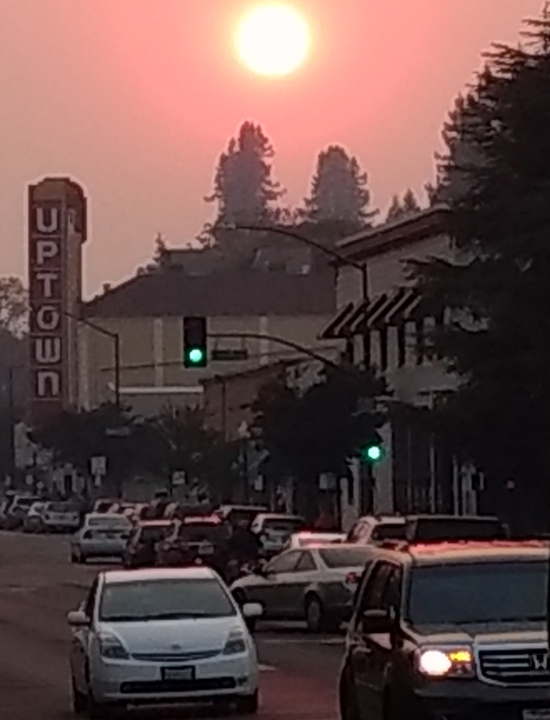
So did this view of the 3 p.m. sun through the haze of the wildfire smoke.

Back in the theater, Only Humans told the story of a man cleaning out his deceased mother’s house and the relationships that he develops with the next door neighbors. The Q&A with Director Vanessa Knutsen reflected much of the film’s significant humor, but saying more here would spoil your viewing experience.

And We Are Boats was an enjoyable and stylish drama, tracking the adventures of a dead woman who returns to Earth with a job assignment to intercede in other lives so she can earn a visit with her surviving daughter. James Bird’s film about life and death packed plenty of social commentary punch, plus he mentioned during Q&A that We Are Boats is the first-ever 100% Vegan feature film. No animals were harmed, worn, or eaten during the entire production, including cruelty-free hair products, make up, wardrobe, and catering.

Day four entered laughing, thanks to The Long Dumb Road, a hilarious film about mismatched serendipitous travel partners. Explorations of class differences provide some weight, but Jason Mantzoukas soars with flights of comic genius. Audience members during Q&A likened Jonathan Duffy’s film to such classics of the genre as Midnight Run.

The next film, Ride, also had its humor. How could it not with rap-hero Chris “Ludacris” Bridges in one of the main roles? And it offered kick-ass BMX tricks and aggressively angled shots of the cyclists in action. And Producer/Actor Ali Afshar and his crew packed the theater to SRO with cyclists who pedaled from miles to form the biggest, most diverse and enthusiastic crowd our room hosted all week. “Is there anyone from the BMX community here?” I asked as part of my introduction, and their response left no doubt.

But in contrast to all the upbeat pre-show exuberance, this adaptation of the life story of BMX starJohn Buultjens was the heaviest film I saw, with brutal scenes of domestic violence, incarcerated youth, and sob-inducing displays of Aryan Brotherhood hate, racism and recovery.

Up onto the Q&A stage — along with Ali and about a dozen cast, crew and BMXers — limped Buultjens himself. We discussed the difficulty of him sharing his life story and seeing it interpreted for film. Although the film is set in Northern California, Buultjens is Scots, and I will never forget the moment during Q&A that he shared his first memory, from age three, “When my dad t’rew me into the burning fireplace.”

From the audience, a man I recognized from earlier in the Festival asked Ali how the film could help rally a movement against hate groups and domestic violence. After Ali answered, I said, “To elaborate on the question Dr. Grant asked, keep in mind the need for action on this front. Of the 953 hate groups in the United States tracked by the Southern Poverty Law Center, two states are tied with 66 each — Texas and Florida — but one state has 75 hate groups, and that’s California.”

After the gasps subsided and Ali and John answered all the audience questions, Dr. Grant met me in front of the stage to begin plotting our own course of action.

The last two films of the evening were You Can Choose Your Family with Jim Gaffigan as the father of two families who are secret to each other until they aren’t and Madness, Farewell, about a man and woman thrown together in circumstance brought on by their desires to commit suicide.

Day 5 was Veteran’s Day.

Our first film of the morning, Summer ’03, was a coming of age comedy (with sprinkles of seriousness) about a teen influenced by her grandmother’s dying words. Next came Thunder Road, another serio-comic romp focused on a cop whose life takes some twists stemming from the eulogy he delivers at his mother’s funeral.

Jim Cummings, who directed himself in the one-man short about the eulogy that grew into this feature, is a stunning actor. His rage scenes reminded me of the all-time greats. As I mentioned in Q&A with Producer Natalie Metzger, “This may be heresy, but I was thinking of Jack Nicholson in Five Easy Pieces.” She explained his technique, the detail of his self choreography, and the process in which the set is prepared to roll, sans the roll-camera-and-slate routine, as soon as Cummings hits his mark.

Are You Glad I’m Here portrayed the friendship between a 24-year-old American woman teaching school in Lebanon and her neighbor, who suffers spousal abuse. Impeccable acting and the collaboration between Director Noor Gharzeddine and writer Sam Anderson, winner of the Festival’s award for Best Screenplay, make the film sing. In Q&A, Sam generously shared information on his writing process, and Noor shared the secret sauce of the film’s exquisite casting, crediting her casting director and detailing the rigor she and Sam also brought to vetting the actors.

We closed with the winner of the Special Jury Award for Best Genre Bending, White Tide: The Legend of Culebra. Covering the true story of a treasure hunt for a couple million dollars’ worth of buried cocaine, genres were so bent that one audience member asked Co-Producers Bryan and Amy Storkel whether they were more influenced by Christopher Guest or Quentin Tarantino.

Watching 22 films in five days, so many of such high quality from names I had not known, provided great inspiration to keep working creatively. Talking with these creators also gave me new views into the why and how of authorship in any medium. Most of all, the experience heightened my appreciation for all my collaborators, past, present and future.

Reaching Youth Sports Summits from Coast to Coast

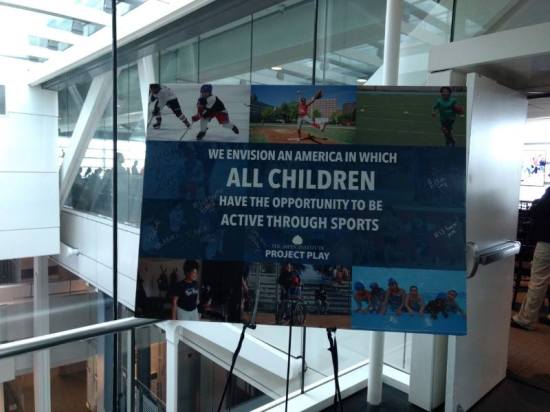
Just outside the Aspen Institute Sports and Society Program’s Project Play Summit last month, I saw a good sign, literally and figuratively. Sitting on an easel, the sign read: “We envision an America in which all children have the opportunity to be active through sports.”

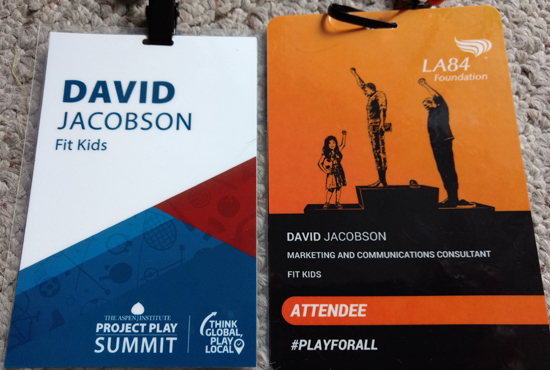
That was a welcome sign for Fit Kids, which I was representing at the event, showing we had arrived at the right place at the right time, even as epidemics of youth obesity and other ills resulting from physical inactivity rage throughout our country. I walked past the sign into a room filled with some 400 other thought leaders in sports, fitness and youth development, who represented teams, leagues, corporations, non-profits, Olympic governing bodies, media outlets, and government agencies.

Tom Farrey, Executive Director of the Sports and Society Program and a frequent collaborator throughout the last dozen or so years of my career, welcomed us and outlined an incredible agenda, with such highlights as:

    • Strategy sessions, including one on “Reintroducing Free Play”
    • Master of Ceremonies and legendary broadcaster Mary Carillo, interviewing first Olympic Champion Jackie Joyner-Kersee and then skateboarder Tony Hawk.

Beyond the obvious star power, it was exciting to learn how all are on the front lines of youth sports and fitness issues. Hearing Kobe explain the challenges of coaching his kid’s middle school basketball team sounded eerily familiar, made us peers for a moment and provided hope for a future in which the rich, powerful and vastly experienced turn their attention to youth sports and fitness. Tony Hawk’s take on how he fit into skateboarding when he did not fit so well elsewhere sent a powerful message to millions of kids left behind by the ever-growing elite youth sports power structure.

The exchanging of ideas, stories and business cards throughout the sessions and into the evening networking event created great potential for Fit Kids to partner and collaborate with like-minded organizations. At the end of the day, all signs pointed to a bright future.

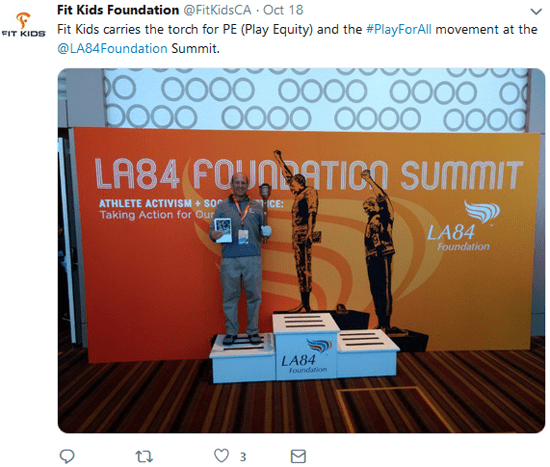
From the heights of the Project Play Summit, I flew to Los Angeles for the LA84 Foundation Summit, convening hundreds more thought leaders in our field. The event surpassed in inspiration its aspirational title: “Athlete Activism & Social Justice: Taking Action for Our Youth.”

Even before the sessions started, attendees could feel the spirit of improving the world through sports by standing in the footsteps of giants. We were given a photo-op atop a replica Olympic podium in front of a sign depicting the iconic moment when Tommie Smith and John Carlos raised fists during the medal ceremony at the 1968 Olympics. We had the choice of holding one of the Olympic torches on display or donning a black glove and emulating the stance of Smith and Carlos.

Again, on the way into the working sessions, I saw signs of like-mindedness, such as an LA84 banner that read: “1 in 4 poor kids are obese. School based sports and structured play is an answer. #PlayForAll”

The on-stage content soared from the start, with opening presentations by LA84 Foundation President and CEO Renata Simril, as well as Master of Ceremonies Sal Masekela, the TV personality and son of the late South African anti-apartheid activist and musician Hugh Masekela. Other highlights, in no particular order, included:

    • “The Legacy of the 1968 Olympic Games and Its Impact Today” with James Blake (former tennis star, who suffered a police brutality incident caught on video in New York City), Tony Dungy and Mike Tirico of Sunday Night Football, and Olympic Medalists Greg Louganis and Ibtihaj Muhammad, who are outspoken on gay and Muslim issues, respectively.
    • “Why I Coach” by Serena Limas, college student, LA84 intern and 2018 recipient of Coaching Corps’ Volunteer Coach of the Year award, who gave her answer in this moving throw-down that melds essay with poetry slam.
    • A panel discussion titled “P.E. is a Social Justice Issue: Working Together to Support Our Youth” with Nichol Whiteman, Executive Director of the Los Angeles Dodgers Foundation, which funds Fit Kids Programs in Los Angeles; Christa Gannon, Founder and Executive Director of Fresh Lifelines for Youth, which helps prevent youth from entering or returning to the juvenile justice system; and leaders of several other organizations.

After the panel, audience members could ask questions. I practically shot out of my chair, and promptly received the roving microphone. To set context for my question, I explained Fit Kids to the crowd, mentioning our work at a dozen L.A. schools, due to funding from the Dodgers Foundation and Los Angeles Lakers Youth Foundation and our collaborations with Positive Coaching Alliance, LA84, and the Saint Sebastian Sports Project.

I then asked any of the panelists to compare, in light of #PlayForAll, the impact of organized youth sports to that of programs like Fit Kids, which offer structured fitness opportunities for every kid, regardless of skill level or interest in sports. The answer, essentially, was “Great question, but we’re getting the signal that we’re out of time.”

A few people approached me afterward, seeking more information about Fit Kids. All of them received our brochure and a promise, since kept, of follow-up emails to explore how our shared paths can lead to better health and fitness for more kids. All signs point to this working out very well.

Tex Winter: A Coach’s Coach

We’ve lost a guru. Tex Winter, the Hall of Fame basketball coach, who assisted Phil Jackson in coaching the Chicago Bulls to six NBA Championships and the Los Angeles Lakers to another four, passed away yesterday at age 96.

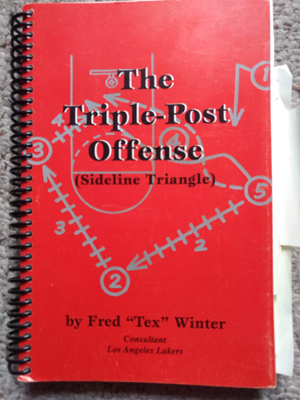
Befitting a guru, I learned at Tex’s knee. Positive Coaching Alliance sent me to interview him during the 2007 playoffs. At practice, it was stunning to see the 85-year-old inventor of the Triangle Offense (aka “Triple-Post Offense”) showing  players a quarter of his age how to curl around a pick, hands ready for a pass and a quick catch-and-release shot.

Tex slouched some, but still moved athletically, with swag that seemed at odds with his cargo shorts and slightly-too-high-up-the-calf tube socks. Kobe Bryant listened to him.

Then, after practice, so did I. We met in an office just off the practice court and talked for half an hour or more about basketball, coaching, and the Positive Coaching Alliance ideals of teaching youth life lessons through sports. Here are the highlights:

David: We want to explore commonalities between youth sports and pro sports, especially regarding life lessons. And to understand the perspective you bring, you’ve been coaching something like 55 years?

Tex: Sixty-two years.

David: Sorry I sold you short.

Tex: I think I’ve coached basketball longer than anyone in history. I’m sure I have. Right off the bat, my first feeling is it has to start in the home. These youngsters go into AAU at a very early age, and the kind of influence they come under in that environment, their reaction’s gonna depend an awful lot on what’s happened in their home. They’re gonna run into all types of coaches. A lot of them do an excellent job. Others do a very poor job. Their motivation is often times negative. It’s not what these youngsters should be hearing, including an awful lot of bad language, I might add.

David: Can you talk about a coach who influenced you?

Tex: Well, you’re talking about  62 years ago, when I was a player at the University of Southern California, and I was very definitely influenced by my coach, Sam Barry, who I felt was a very good teacher. He was interested in the lessons of life. I don’t think I ever heard him swear.

David: Tell me about one of the life lessons Sam Barry taught you.

Tex: You could sense the example, keeping a clear mind, keeping a clean mind. I took the lessons from my coaches in high school, junior college and at USC and carried them over into my coaching philosophy, which is considerably different than what I see today in a great deal of coaches, including, unfortunately, some of the most successful coaches. One of my discipline rules was that I didn’t want any bad language. I didn’t want the Lord’s name used in vain…maybe occasionally a ‘damn’ or ‘heck.’ My coaching sessions just didn’t have any swearing, not like today, where sometimes I see examples of nothing but that.

David: How do you think that affects the athletes?

Tex: You take a coach that is a figurehead for them at that early stage in life, and they’re apt to be very much influenced by how the coach presents things, including the lessons of life, and whether or not there’s a lot of swearing and the kind of language we hear today in rap music, for example.

David: Are there life lessons inherent in the game of basketball itself?

Tex: I think very definitely. Hard work. You’re only a success for the moment that you perform a successful task. You participate with a happy warrior attitude, where you’re more concerned with the effort that you make, as opposed to winning or losing. I very seldom talked about winning or losing. It was more the Roger Bannister philosophy of happy warrior. He wrote considerably about that and it was one of the sources I used in my coaching, the happy warrior philosophy. Enjoy the thrill of competition. Do the best that you can do. That’s all that anyone can expect of you. But don’t shortchange yourself. Those are important lessons.

David: Do you discuss issues of character with these guys?

Tex: I do on an individual basis. But I don’t think it’s my place to really set a tone as the far as the team itself is concerned. That’s up to the head coach. It bothers me that I’m not in a position to speak up and be a little stronger on some of the things I see.  Then again, you see players who are concerned a whole lot more about character than some of the others. One of my all-time favorite players is Steve Kerr, tremendous character.

David: You’re most known recently for developing the Triangle Offense. Are there life lessons inherent in that?

Tex: It teaches cooperation, team concept, being a part of a group, and not being individualistic, because it’s an offense that requires ball and player movement. It teaches having trust and depending on your teammates. I see an awful lot of the lessons of life that can be taught in the basketball philosophy that we teach.

David: Despite the complexity of some of the diagrams I’ve seen, I might like to teach that offense to the 12-year-olds I coach.

Tex: That’s where it should be taught. It’s a very basic offense. The principles are ball movement and player movement with a purpose, spacing on the floor, penetration, offensive rebounding and defensive balance on all shots, creating operating room for your teammates, and keeping the defense occupied on and off the ball. I’ve often said it’s a junior high offense.

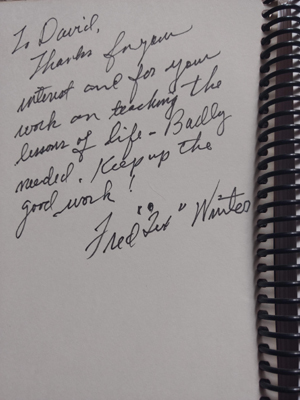
That was all it took to convince me to install the Triangle for the junior high team I was coaching. After all, I’d just learned the principles from the man who literally wrote the book on “The Triple-Post Offense.” To make sure I coached the Triangle as well as I could, Tex pulled a copy of that book off his shelf and inscribed it to me, and it remains one of my proudest possessions.

Voices We Need to Hear

We need more voices.

That much became clear on February 16, 2018 when Black Panther made its nationwide debut. In the theater with three black friends I met through pick-up basketball and about three hundred other people – many in identity-affirming attire that ranged from traditional African to contemporary Wakandan – their pride was palpable. “Finally, a flick where the superheroes look like us, a film made For Us, By Us.”


Image from Wikimedia Commons

Don’t underestimate Black Panther’s importance either on the basis of who was in front of the camera or who was behind it and as a matter of employment, example and inspiration. Films like Black Panther, and now Crazy Rich Asians, send a message of hope to people from populations that are under-represented in mass media, entertainment and other creative industries: they can and should aspire to share their voices.

And we need more of them. Unless your political leanings include bigotry, you will agree our democracy needs the widest possible diversity of voice. After all, the word “democracy” derives from the Greek “demos” (people) and “kratia” (power, rule). Or, in the words of a real-life Black Panther, “power to the people.”

Lacking a “one person, one vote” style of democracy in America, it’s even more critical to pursue the “one person, one voice” approach. That’s what makes Twitter, however misused, so popular and so powerful.

But an individual’s ability to Tweet is no substitute for proportional, representative voice in traditional mass media –TV, radio, newspapers, film, advertising and other artistic and creative endeavors. Films such as Black Panther and Crazy Rich Asians generate so much buzz because they are anomalous in their inclusiveness and messages of empowerment to people of color. The films’ mere existence lulls much of the public into belief that we now live in a post-racial media world. Meanwhile, under-representation of voice persists in undermining our democracy.

Thus, the importance of WeXL, a fledgling non-profit devoted to:

  • developing diverse creative-industries talent from under-represented populations
  • creating opportunity for those creatives through networking that leads to greater employment, empowerment and share of voice
  • providing authenticity for the clients who hire WeXL actors, directors, producers, artists, performers, and, yes, even writers.

That’s why this writer gives time to WeXL, including participation in the organization’s Mentor Monday series and a presentation September 17 at 7 p.m. in San Francisco’s Google Community Space. Mentorship and encouragement for the young and the restless, those who compose WeXL’s creative community, benefits not just them, but can also  trickle up to benefit others.


At Mentor Monday with Ci’era London

If WeXL sounds overly aspirational, aiming too high for such a new organization, consider the bottom line. Films like Black Panther and Crazy Rich Asians make bank: $1.3 billion in box office sales for the former and $164 million for the latter, making it the highest-grossing romantic comedy of the decade.

WeXL members are not looking for a hand-out or even a hand-up. They are banding together to earn a living doing what they love, to contribute economically and socially, and to find and share their voices with a public that very much needs to hear them.

Eclipsed

The longer I live, the more clearly I hear what the universe is telling me. I listened a few years ago when Kathy Bresler recommended a subscription to the BrainPickings.org e-newsletter, which on July 17, 2017 covered When Things Fall Apart by the Buddhist nun, Pema Chodron. The excerpts in the BrainPickings newsletter made Pema’s book seem a good read for Tina, my supervisor at Positive Coaching Alliance, who was on leave because things fell apart for her when her father faced sudden, serious health challenges.

The day I learned of Pema’s book, I mentioned it during a phone call with my friend, Ann, who lives up in Kennewick, Wash. Ann called it the most important book in her life, key to sustaining her sobriety.

The next day I mentioned the book over lunch with my co-worker, Shelley. She also exclaimed the book’s importance as a basis of her own Buddhism and a force that helped her accept and embrace even the most difficult changes life can bring.

When several influential people in my life all at once try to fill the same gap in my knowledge or experience, I understand that the universe is trying to tell me something. So I listened. I read When Things Fall Apart and gave Tina her own copy when she returned from leave. Less than two weeks later, on August 3, Tina tearfully told me she had to lay me off just a month shy of the 12th anniversary of her hiring me. My last day there would be August 16.

Within minutes of the initial shock, Pema’s message surfaced in my mind. Her lessons about the inevitable, painful change that life brings helped me survive that moment, and because her message had arrived so serendipitously, it seemed ordained that I could accept and embrace this difficult change. I became attached to When Things Fall Apart the way other people attach to their Bible or Koran.

The book’s arrival as largesse, courtesy of the universe, got me thinking how some turns of phrase equate inexplicable good fortune with interstellar events. If something is meant to be, “it’s in the stars.” Right-place-at-the-right-time moments happen because “the planets must be aligned.”

My cosmic musings soon had me hearing the universe tell me to go to Oregon for the solar eclipse. Unemployed and in need of a vision for next career steps, I planned to leave in three days, listen to rivers while sleeping on their beds whenever possible, cross Crater Lake off my bucket list, and witness the eclipse in its path of totality at Madras, Oregon.

I packed my Mazda with camping gear, road snacks, Pema’s book and another that guides my spirituality, Luther Standing Bear’s Land of the Spotted Eagle. Preparing for  what amounted to my version of a Lakota vision quest (which, in Trump times, I knew would involve socially purposeful work), I needed Standing Bear’s consideration of the Great Mystery of nature at the heart of Lakota spirituality and what the wasichu has wrought.

Leaving home the morning of August 19, I spent the first hour of my vision quest seeking NASA-approved eclipse glasses, which 7-Eleven stores were offering for free. Several stores were out of stock. It dawned on me that if my pace to Oregon did not speed up, there would be no need of eclipse glasses, anyway, and chances were that I would find another 7-Eleven along the 550-plus miles to Madras.

I crossed the glassy San Francisco Bay over the San Mateo Bridge, passed glass towers of East Bay towns trying to be cities, rolled over decrepit railroad tracks built in a time when our country had a future, past dust devil dancefloors of fallow farms that fail to feed the fieldhands who work to feed us, only to be demonized and deported back to the violence they feared enough to flee to our violence. At a Safeway in Redding, where I bought water, almonds, peanut butter and beef jerky, the parking lot was full of tweakers. But those frustrating Americanisms were somewhat soothed by a burger and a beer and the sight of Calatrava’s famous Sundial Bridge.

Then came the natural scenery of the Lake Shasta area, Castle Crags and Black Butte and other majestic-but-less-famous-than-Mount-Shasta formations. Depending on the highway curve, they resembled the new problems in my life, looming deceptively large from a distance and seeming to shrink to less imposing heights up close.

Snow-covered Mount Shasta offered no such illusions. It is just one giant mountain.

The next natural feature of note after the split off on Highway 97 and crossing the Oregon border was Upper Klamath Lake. Forest fire smoke gave an unnatural orange to the setting sun, and from one angle, Aspen Butte slashed diagonally across the orb, so it looked like a quarter-eaten pumpkin pie.

Near dark, I decided to camp at Jackson Kimball State Forest, pitching my tent by the light of my cell phone clenched between my teeth. Coyotes howled most of the night in a surprising variety of voices, some so distinct – real, dreamed or imagined through on-again-off-again sleep – that I picked out the sounds of several individuals. They became distant pets in the night, playing a rhythm-and-echo game with a herd of terrorized cattle bellowing in the distance.

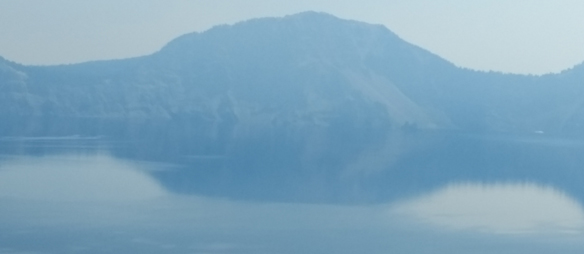
I hit the road at ten for Crater Lake. Hiking the Rim Trail reveals one of those rare views that match its hype. Crater Lake is a blue you can’t see anywhere else.

About 90 minutes later, wildfire smoke almost completely obscured the lake.

The park offers a lot of other scenery along a loop drive, including Vidae Falls.

Out the southern edge of the park, Highway 62 rolled to the Rogue River National Forest, where I pitched my tent at Natural Bridge. This would be my first night of this trip to listen to a river and perhaps receive a vision. That seemed to call for some form of purification ritual analogous to the Lakota inipi.

While pale in comparison to what a traditional vision seeker endures, my wood-gathering turned into a self-imposed, quixotic, ascetic challenge to carry as much as possible as far as possible in the sun-setting heat. However brave I felt four days after being cast out from my professional home, that wood-gathering was a needed emotional purge. Then, in the cool dusk and overnight, the river whispered especially sweet secrets.

And in the morning, less than a mile’s hike away, the Rogue roared. It reminded me of Lower Falls in Yellowstone – not as tall and majestic, but just as effective in eliciting involuntary ego loss.

The river’s whisper and its roar both echoed inside me. Otherwise, I felt empty. Back in the car, creative and artistic visions took shape. I drove blissfully to Bend, where the universe delivered me those 7-Eleven eclipse glasses. I’d only snacked since that burger two days before in Redding, so lunch was a steak sandwich splurge at Deschutes Brewing.

Friends had recommended Bend for its natural beauty and recreation opportunities, but lingering there would keep me from finding a campground close enough to Madras to get there in time for the next morning’s eclipse, given the apocalyptic traffic predictions. First choice, Tumalo State Park, was packed. A ranger said she’d just called Prineville, and they had plenty of space, but none by the time I got there. Jasper Point also had no vacancies. I asked the campground hostess what she would do in my shoes, as I did not want to violate any laws sleeping roadside in my car.

“Can you do without electricity?”

“Sure.”

“OK, well, you see that stop sign, about 50 yards outside the gate? You take a right, onto that unpaved road. Anywhere you see a pullout is a campsite. They’re free, because they’re undeveloped, just a pit toilet. I’m so sorry, but that’s the best I can do.”

The jagged rocky road threatened my tires, which were overdue for replacement, so I took the first turnout. Beyond the parking area, and that pit toilet (which, on my third night on the road, was the cleanest I’d had yet), a grassy hill sloped down to the reservoir. It lapped at the shore during a mellow sunset and all through my sleep and when I awoke at sunrise.

In Prineville, I stopped at the first place that sold coffee, figuring it was not the kind of town to offer much selection. The coffee was bitter and burnt. Leaving out the other end of town took me right past a Starbucks, but I did not want to pay for more coffee. Instead I paid penance for my metropolitan bias, which assumed that Prineville could not offer quality coffee. Newly sensitive to my narrow views, rolling down the road to Madras past rural poverty and dead soldier tributes, it was easier to see how people in so-called “fly-over country” would vote differently.

The hysterical traffic forecast never materialized. A few pockets slowed over the last five miles. Many cars randomly pulled over for eclipse viewing from the shoulder, and some paid sites had their fields covered with rows of RVs. By eight, I was parked in downtown Madras, sipping delicious coffee at a picnic table in a food truck court near Sahalee Park, and testing angles toward the sun with my cell phone camera on a tripod.

I tried tricks I’d heard, such as draping eclipse glasses over the camera lens, but no cell phone photo can do an eclipse justice. That’s OK. Relying on mind’s-eye photos can make an experience more memorable.

The sky slowly darkened. The air cooled. People murmured and shouted as totality neared. Then, for about two minutes, all that remained of the sun was a brilliant blazing liquid-chrome rim the color of the Silver Surfer. Two days after seeing the nowhere-but-here blue of Crater Lake, I saw the nowhere-but-here-and-never-but-now shine of a disappeared sun.

Later on when the crowd thinned out I wandered the streets looking at souvenirs. I left around noon so I could make it to Ann’s house in Kennewick on time for the dinner we’d planned. It took an hour to get out of Madras and another hour before traffic loosened enough to really move.

Around three, a tire blew out. From the shoulder, with cars speeding dangerously close, and no experience changing tires, I called Mazda roadside assistance. I was so far from anywhere identifiable that, even with Mazda using its GPS, they asked for descriptions of physical aspects of the landscape to help figure out where to send help. They said they would have to call back.

While waiting, I re-read parts of When Things Fall Apart to remind me how to embrace this unwelcome change. Minutes later an official highway rescue tow-truck pulled up and two real men put my spare on in about 10 minutes. As they did, Mazda called back and said it would cost some hundreds of dollars and at least three hours because of my remote location, and by the way, didn’t I know that the roads were crowded because of people wanting to see the eclipse earlier that day?

The tow-truck crew thought the spare could make it to Kennewick if I kept my speed under fifty. That meant I would not reach Hermiston for tire replacement before closing time, so I should pull over and check the heat of the spare compared to the other tires, because if the spare blew I’d be stuck in the countryside until I could get a tow. I offered them $20 for  beer in a coded attempt to regain a sense of masculinity, but they refused it.

Less than thirty minutes later, I was in a seven-mile back-up in Wasco, waiting an hour-and-a-half to turn from highway 97 to highway 84. But (I summoned Pema), what beautiful rock formations out my windows! Such intricate Mighty Favog faces and patterns you’d see as a child when you had nothing but time! What a blessing to recall the eclipse image—“best album cover ever!”

Other than fear of tire troubles, I loved 84, which skirts the Columbia River with its barges, its John Day Dam, its barren hillsides, and its spectacular swallowing of the setting sun in my rearview mirror as I hit Hermiston. The spare was warm, but I decided, in all my vast automotive expertise, that it would be OK.

During another 90-minute delay in a two-mile backup to get onto 82, my rearview showed a drunk staggering up behind me holding a wrinkled bag of booze. He wandered past  again, coming from the other direction a half hour later, holding a new bag, and it was another 15 minutes before I saw the liquor store.

Once through that back-up, the homestretch to Ann’s house was a grooved road over the bridge and onto the interstate. I encouraged my tires out loud that they could make it. They did! And only five hours late for dinner! Ann and her husband, Jim, and I spoke deeply that night and over the next two days. Some of the topics were personal and painful, born of the trying experiences that had led us to Pema.

The eclipse experience remained vibrant, too. Folks standing in line with me at Discount Tire started talking about it. The guy in front of me showed me a photo on his phone that matched my memory but far exceeded the quality of anything I could shoot on my phone.

“How did you get that on your phone?” I asked.

“I transferred it from my $20,000 camera.”

After two days of rest and real food and clean sheets at Ann’s place, I took off for Portland, completely relaxed and able to enjoy the piney scenery of the Columbia River Gorge, near the town of Hood River. I stopped to see Horsetail Falls.

I had to make that quick to be on time for my visit with Pastor Craig Brown, whom I had not seen since our playground basketball days in high school. We caught up for a couple hours sitting in the sanctuary he was rebuilding in his historic church, and I heard every war story he was willing to share from the streets of Milwaukee to his tours as an Army infantry sergeant in Iraq. We had taken much different paths to the peace we felt that day.

That night I slept on a river bed about 40 miles outside Portland at the Gales Creek Campground in Tillamook State Forest.

In the morning, I aimed for Silver Falls State Park, about a two-hour drive, and decided to try the Trail of 10 Falls.

It was one of the most spectacular hikes of my life, winding past, behind, and under the 10 waterfalls that provide the trail’s name.

Between waterfalls, the trail meanders along a creek and through dense forests of fern and moss in every shade of green you can imagine and some you can’t.

The beauty at every step helped ease the pain that accumulated from all those steps. Even without the waterfalls, the hike through such rich and varied greenery would have been worth it. But when you hear that thunderous falling water and wonder what it will look like, and then catch a glimpse where the trail curves, your pain fades, and you keep on until just the right slant of late afternoon light strikes the falling wall of water and rainbow flame licks dance from its edge.

Going around the bend after one of the falls, I saw a woman standing on the trail, writing in her notebook. I stopped, “Are you a poet?” I asked. It started a conversation that probably lasted 10 minutes.

We covered the usual where-you-from and what-brought-you-here, but what had brought us each there was deep. She’d been eclipsed, too, something about a man and then the need to drive from Ohio just to watch the sun — which keeps us all alive — disappear in broad daylight and then re-appear to let us know that even apparent cosmic cataclysm is just an illusion.

We fellow road warriors, wanderers and wonderers were both so raw, so vulnerable and awestruck from recent past days of packed senses and surges of urgency that soon we were both near tears. Even as we each acknowledged our unusual openness while it was unfolding, it still seemed completely natural that we strangers bare souls.

From my backpack, I pulled out Pema for a passage that would remind us both that everything would be OK. Some other tangent, maybe what we’d each observed on our hikes, prompted me to also pull out Standing Bear and flip – more quickly than I expected to be able, as though I’d been practicing – to the page where he shares the Lakota wisdom “He iye ki ya mani yo” (“Recognize everything as you walk.”)

I realized that between my five-day beard, my camp smell, my fatigue, my sensory overwhelm from the waterfalls and the ferns and the eclipse, and now my proselytizing from two strange and off-the-beaten-path books, that she was ready to back-pedal down the trail. I also caught myself experiencing for the first time a faith so full that I could not prevent its overflow. But she’d had enough, so I quieted and wished her well, happy for the mindblow that waited for her in the waterfall around the bend that I’d just come around.

Finishing the trail at seven I was exhausted and in minor pain. Sleep sounded good, but I doubted my luck at finding any more perfect river beds on this trip.

Instead, I loaded up on diner food and coffee and sped 10 hours through the starry night back to the Bay Area, at home on the road, comfortable with being eclipsed in a universe that showed me there are times when things fall together.

Striking Out in the Dominican Republic

In the beginning, I thought of baseball as soon as Val told me we were going to the Dominican Republic, the offshore home of two great American pastimes – baseball and colonialism – that meld in a steamy stew of cultural imperialism.

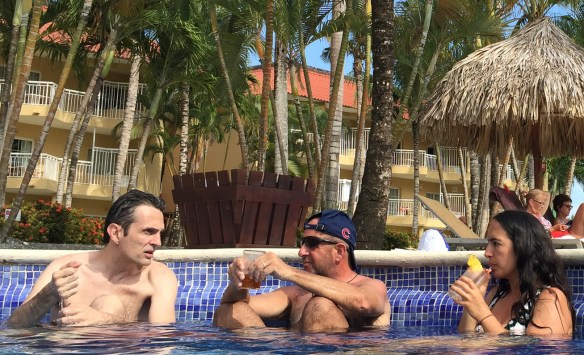
My wife, Val, works for a software firm that each summer takes its distributed workforce out for a retreat. Celebrating the company’s 10th anniversary, the founder this year hosted employees’ families, too. About 80 of us from the U.S., South America and Europe met at Dreams-Punta Cana, an all-inclusive resort on the Dominican Republic’s east coast.

Where some folks’ fantasies run toward sun and sand, mine turn to bat and ball. I mentally unwrapped a pack of Dominican all-star baseball cards: Pedro Martinez, Vladimir Guerrero, Juan Marichal, Manny Ramirez, David Ortiz, Albert Pujols, Rico Carty, the euphoniously named Julian Javier, and those two tragic figures from my beloved Chicago Cubs, Sammy Sosa and Moises Alou.

I started plotting how to find the heart of Dominican baseball, knowing that the company’s retreat agenda left little time for side-trips, especially when the destination was “I’ll know it when I see it.” It would be the mythic rock-strewn lot full of skinny shoeless boys fielding bad hops with ragged gloves (or none) and rocketing line drives off nailed-together bats, because, as the local saying goes in explaining Dominican players’ aggressiveness at the plate, “You can’t walk your way off the island.”

Weeks before our trip, I location-scouted by phone, first with my friend and former sports-business colleague, Valerin Lopez, a Dominican native raised in New York, who occasionally returned to the island. Then I checked in with my baseball guru Terry Shapiro, whose expertise lies in Colombia, but who knows everyone. I emailed Gene Corr, whom I met on a discussion panel at a screening of his film — “Ghost Town to Havana” — about a baseball coach from inner-city Oakland taking his team to play in Cuba. Gene connected me with Tommy Goodman of the Caribbean Educational and Baseball Foundation. None offered specifics on when and where I might see my vision.

So I just started looking as soon as our flight landed. On the half-hour ride to the resort, the airport shuttle bus windows showed mostly a concrete landscape of strip malls and cell-phone towers. If not for the Spanish on the billboards, we could have been 10 miles outside of any U.S. city.

But the view changed inside the gate that swings open at the front of Dreams-Punta Cana to swallow whole busloads of tourists and in the high-ceilinged lobby of the main building, where fans whir over wicker furniture that invites your already-heat-and-humidity-weary self to rest and wait for the waitress to bring whatever you drink and as much as you want of it or more. From there a wide marble spiral staircase leads down to a disco, a casino, a theatrical stage that hosts a nightly revue of stereotype island entertainment, a gift shop, several restaurants, and a cigar stand.

Outside the building is an amusement area with a video game arcade, pool table, foosball, ping-pong, a climbing wall, an archery range, basketball and tennis courts and a batting cage. Within the one-mile circumference of the perimeter road, another dozen three-story guestroom buildings surround the half-mile long central swimming pool and other amenities, including a massage and hydrotherapy spa, a flamingo pond, lawn patches, foot bridges, a waterfall, and a bar or restaurant about every 50 yards, including that holy grail, the swim-up bar. The whole complex dead-ends into a plush beach and calm turquoise water.

Val and I, along with our “millennial” children, Eleni and Sam, headed out from our suite ready for lunch at the restaurant nearest the beach followed by tossing a baseball around on the sand. Playing catch on our walk to lunch, we started hearing “Beisbol!” from waiters at the other poolside bars and restaurants.

One of them held up his hands in the international “throw-it-here” sign. His return throw showed enough control, break and style that we stopped to exchange tips on grips and other pitching tricks in his broken English and Sam’s broken Spanish. One of my knuckleball experiments landed in a thick hedge. Our new friend, Francisco, waded right in, nevermind his server’s jacket, and found the ball.

It was the first of many humble acts of service from the resort staff, who make Dreams-Punta Cana so special. Later in our stay, I thanked a waiter for the quality of the coffee and asked where to buy two pounds. He did not know, but 10 minutes later brought the ground coffee in bags and said there would be no charge. On my way out, I gave him $20 to cover the cost of the coffee and a tip. His eyes widened like he’d seen a ghost.

I could only imagine his life, presumably poor like most everyone on the island (thus, the baseball players’ commitment to swing their way “off the island”) and feeling forced to meet the whims of, mostly, descendants of the colonialists that created that poverty. Then my white-guilt moment faded into an easy weekend rhythm of eating, drinking, pool lounging, and an occasional run or Frisbee game or baseball catch on the beach followed by an ocean dip and hitting the indoor bars to watch World Cup soccer.

That weekend, Sam told me he’d planned with Francisco to get a few of his colleagues to commandeer a resort shuttle on Tuesday and drive us all to a ballfield in Higuey. It seemed we would have something even better than that baseball moment I’d envisioned, actually playing with the locals.

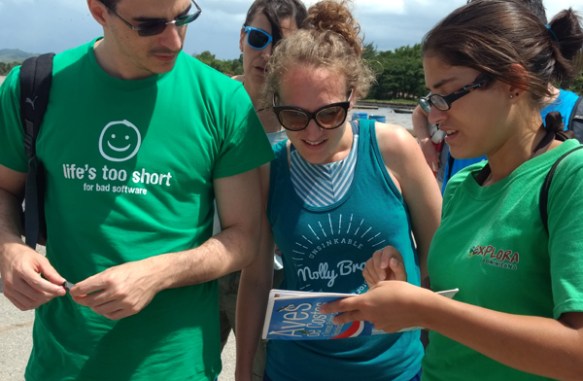
But first, on Monday, Eleni and I joined about 10 of Val’s co-workers for a kayaking trip in Parque Nacional Los Haitises led by Explora Ecotour. Our shuttle left painfully early in the morning, but I was jolted from self-pity after about 45 minutes at first glimpse of the island’s tragic poverty.

Some highway stretches just showed a blur of misery. Other times, traffic slow-rolled through whole towns of crumbling buildings, missing walls or roofs or both, skeletal elders seated on concrete floors in the hope-sapping heat and humidity, decrepit fume-spitting motorcycles with children perched precariously on handle bars, and cave-chested, rib-bare boys on horseback.

Some towns’ commercial centers consisted of a school surrounded by razor wire, a barber shop, a restaurant, a bar with a sign for “no menores/no armes de fuegos.” The best-dressed wore NBA team t-shirts commemorating championships never-won – the ultimate hand-me-down U.S. cultural detritus — answering the question of what happens to the pre-printed championship t-shirts for the teams that don’t win a game seven and confirming to those wearing the disposable losing-team shirts that the dominant U.S. culture also treats them as disposable losers.

Beyond some of these town centers lay scenic backdrops of forests layered in every shade of green imaginable, sloping toward the ocean that displayed just as many blues. When the road rose you could see both heaven and hell.

The final stretch to the national park was a pitted, unpaved path. Our Explora Ecotour guide, Eloisa, started pointing out features of plant and animal life, including the cattle egret, a bird that lives symbiotically by eating insects off the cattle that the insects otherwise would eat. Eloisa, a biology student from Venezuela (and therefore now practically a refugee), knew her stuff.

She hired local on-water guides at the kayak launch and led our easy paddle on the brackish green river, usually no wider than 20 feet, beneath a mangrove canopy. Several times she directed us to the river banks to let local power boats pass, and she alerted us to sights we could have missed, such as a blue heron picking off the tiny crabs that scuttled up the mangrove root.

Where the river emptied into a bay, our paddle power picked up. Eloisa led us for about a mile across the bay toward a cliff she described as a bite of cheese. The frigatebirds that soared above us with their distinct scissors-tails she called “air pirates” for their practice of stealing prey mid-air from other birds. An armada of pelicans flew past, low and large.

We nestled up to the cheese-bite cliff, felt it, eyed it from all angles to find patterns, forms and faces like you do when looking at clouds. We paddled around some smaller outcroppings of rock and coral for about 15 minutes until it was time to turn back across the bay, working hard in the heat, and then cooling again under the mangrove canopy.

Back up the pitted path in the town of Sabana de la Mar, lunch was fried fish and plantains and rice and beans beneath the thatched roof of Restaurant Jhonson. Wondering about the poverty, I asked Eloisa, probably less delicately than I hoped, how she felt about Explora Ecotour contributing to the economy but also potentially opening the region to further exploitation.

Her calm answer stressed the positive impact of any outside money, even the portion of our fees that bought us lunch. Eloisa detailed the exploitation wrought by Brazilian construction and engineering company Odebrecht SA, whose corruption scandal forced it to abandon a local project, and then she showed us the fallout on a walk of the town’s battered pier, another foreground of want against a beautiful backdrop.

Tuesday morning we trained for the baseball game Sam had planned with Francisco. Sam, Eleni and I visited the batting cage and its gleeful old coach who yelled “hola!” each time he fed a ball into the pitching machine. Carlos, the husband of one of Val’s colleagues, joined us in the cage. A Venezuelan now playing pro baseball in Italy, Carlos proved that he was our best chance against the stuff Francisco showed us on day one outside the restaurant.

At the appointed hour, we waited for Francisco on the wicker chairs at the front of the resort, but he no-showed.  The next day we learned that Francisco’s broken English and Sam’s broken Spanish had left us waiting for Francisco to bring the shuttle while he had spent the whole day at the stadium in Higuey, wondering when we were going to show up on that same shuttle. My baseball dream was dashed.

For our last full day in country, Eleni and I joined a group taking the tour bus to Santo Domingo. Our guide this time was “Nacho,” who sounded like Garrett Morris’ Chico Escuela character and looked like Godfrey Cambridge, circa “Watermelon Man.” Nacho was in his sixties, a retired educator, now earning money and perhaps peace of mind by setting some historical records straight for tourists.

His quasi-minstrel comedy act strained to keep us entertained enough to listen to the not-funny truth. His speech ranged from “fasten your seat belt” to “don’t engage street vendors” to “stay with our group so you don’t miss the bus and pay for a $250 taxi home” to “Christopher Columbus landed in 1492, when the island was home to 600,000 native Tainos, and 13 years later they were all dead.”

Throughout most of the three-hour ride, Nacho bantered with the driver, Enrique, and raised his voice to a feminine tone when joking about the local MamaJuana aphrodisiac elixir of rum, red wine, honey and herbs. Mid-act Nacho started working us for positive reviews and tips.

Unlike the local roads of our kayaking trip, the interstate-type highway kept us more distant from the worst views of poverty. Nacho still made his points about the sugar cane industry growing on the backs of slaves and who held power and land at what point in history, dropping the names of property owners, such as Beyonce, Robert Redford, Liza Minelli, Oscar de la Renta, and Donald Trump.

At our pit stop, Nacho warned us to be back on the bus in 15 American minutes, because 15 Dominican minutes would be more like three weeks. Re-boarding, Nacho counted each of us as we passed him in the aisle and said “Forty-four” as he tapped my shoulder. I said, “Just like Hank Aaron.”

He smiled wide and said, “Ricardo Carty’s old teammate!” When I recited Rico Carty’s .366 batting average that won him the 1970 National League batting title, Nacho said, “I use be berry berry good beisbol.”

His schtick stayed just this side of revealing a minstrel’s self-hate, which could have had me hating him and myself for complicity in his loss of dignity. But he knew when to quit that act. The skies darkened and sprinkled as we neared Santo Domingo. Enrique slowed the bus and Nacho directed attention to the Christopher Columbus Lighthouse, an ambitious and expensive piece of architecture that had drawn disdain for seeming to celebrate the genocide its namesake started.

Our three hours walking along cobblestones in Santo Domingo centered on Columbus: a palace, a museum, whips, chains, cuffs, branding irons, Bibles, canons. Another stop was a 4-D movie complete with slamming theater seats and sea spray to depict the 1586 conquest of the city by Sir Francis Drake. We visited the National Pantheon where an honor guard stands silent and still amid the crypts of national heroes.

Our lunch stop was Buche Perico, a beautiful restaurant with an indoor waterfall that tumbled behind our table and was later drowned out by a bachata dancing demonstration. Nacho ended the formal, educational part of our tour solemnly at the oldest cathedral in the Americas, the Cathedral of Santa María la Menor.

There was a shopping stop afterward. Along with the normal trove of souvenir kitsch, the place sold a great collection of local food, drink and cigars, plus jewelry of the unique native gems, amber and larimar. I was disappointed to find no baseball memorabilia worth buying, not even a Dominican national team t-shirt.

On the way back to Punta Cana, I stared out the window, feeling fatigue from heat and humidity, feeling depression from seeing too much oppression. Learning about history is interesting but not always uplifting. I started dreading the three-hour ride beneath gray skies back through sugar cane country, where Nacho would tell us more horror stories.

But around a bend in the road, outside a nameless town downhill from the highway appeared a patch of dirt and a bunch of boys chasing a ball and others running in the rough shape of a diamond and many more waiting for their chance to swing their way off the island.

Long Shot: Conversation with Craig Hodges

The loudest noise I ever heard rose in a roar toward the top row of the old Chicago Stadium, thanks to a dagger to the heart of the hated Pistons from the hand of Hodge late in game one of the 1991 NBA Eastern Conference Finals. More than a quarter century later, Craig Hodges makes news and noise of even greater importance.

In Long Shot: The Triumphs and Struggles of an NBA Freedom Fighter, Hodge recalls his life of activism — fully woke from the jump — that led to his being blackballed from basketball. Following Hodge’s appearance on a panel discussion at the Socialism2017 conference in Chicago, we sat for this interview, thanks to Long Shot publisher Haymarket Books.


IMG_20170708_185324118

How Coaches Build Cultural Bridges for Youth in Our Divided Nation

Quinteros, GersonSports can help bridge the cultural divides that afflict our country. The cauldron of competition forges bonds between people who otherwise would remain unconnected and perhaps fearful or hateful toward each other.

Youth and high school sports are particularly important in this realm, because they can counter the culture of divisiveness before it roots in young hearts and minds. The huddle, the dugout and the locker room are great places for children to learn that we are all one race, human, and that we must work and play together in order to conquer any opponent, including ourselves, and win not just in games but in life.

The best coaches lead these efforts. Every year Positive Coaching Alliance honors youth and high school sports coaches whose goals are winning and more importantly teaching life lessons through sports with the Double-Goal Coach Award Presented by TeamSnap.

Every year, I interview candidates for the award. Every year, it is emotionally wrenching to hear of the extreme highs and lows the coaches and their players experience. This year, the divisive political climate, racial tensions, anti-immigrant sentiment, class warfare, and mounting social ills, ratcheted the emotions of these interviews to record heights.

Here are excerpts from 12 of the interviews:

Mariano Albano, Alacranes de Arizona (soccer), Phoenix
For Albano, a retired City of Phoenix police detective, “education comes first,” he said. “Finish school, no matter what. Do whatever is in your power. If you need help, ask. I never finished high school. I grew up in the inner city of Phoenix, and I started working when I was 13. Coaching for me has always been about kids furthering their education, teaching them there are other things in life. In 1988, I started taking girls to Europe to play in major competitions, so they could see that there are other worlds out there, other cultures. I took any kid. It didn’t matter if they were one of the millionaires from up in Paradise Valley or if they lived in a shack down in South Phoenix.”

Wes Bateman, Reseda (CA) High School Softball
“After the election, some kids were upset and having a hard time with their feelings about it. We talked about it being OK to have those feelings, but if you don’t handle that in a productive and constructive manner, then that’s going to be destructive to you as a person.”

Kevin Castille, St. Thomas More Catholic High School Cross Country and Track and Field, Lafayette, LA
Castille brings his own redemption story to bear on the youth he coaches. As detailed in this Runner’s World article, Castille dealt drugs for about 10 years, paid his debt to society, and now, as one of the nation’s top master’s runners, who contended for the 2016 U.S. Olympic marathon team at age 43, speaks from a position of experience and authority in guiding youth toward healthy lifestyles. “Without parents, I was bred for that life. I just did not understand what I was supposed to do. As a kid raising myself, I did not know how to make adult decisions, but I got a second chance at life. When I’m with kids, I tell them they don’t want to go there.”

Joe Eassa, Unity Preparatory Charter School of Brooklyn (wrestling)
Eassa impacts a wildly diverse student body that has up to 90 percent of its students receiving free or reduced lunch. “I keep my numbers kind of small, 10-12 kids, and take them on as family. I talk to their families every week. I sit in their classes; if they don’t have the grades, they don’t wrestle, and they don’t come to practice. This helps me get them to understand the importance of what may seem like little decisions they’re making academically and behaviorally. The biggest thing for me is letting my guys know I care about them, that I’m going to be persistent, and that change is urgent.”

Eassa also has the chance to impact the life of his community as a whole, especially in terms of uniting such a diverse population. “As a white guy in Bed-Stuy, I grapple with this all the time,” Eassa said. “Race is a major issue. But I’ve found from my coaching and teaching that as long as you’re there for people, and you’re consistent and give them unconditional love, that bridges cultural barriers.

“We have some refugees from Yemen and a lot of Mexican students, and their (deportation) concerns are very real. It’s been emotional. I tried to be as calm and even-keeled as possible and acknowledge these concerns. You listen. You hear. You try to explain some inaccuracies. At the middle school level, some stuff can get sensationalized. If you come in upset, the kids will do the same exact thing you do. I try to lead by example, and just acknowledge that some of these things that are happening are very scary.”

Breeze McDonald, Earl Watson Elite Basketball, Los Angeles
“I believe in ‘Each one teach one,’ and I believe it takes a village. By establishing relational trust with my players, I help them establish relational trust in other aspects of their lives. Our players come from a wide range of backgrounds, some more privileged than others, and I teach them how to be culturally responsive and linguistically responsive with each other, on the court, off the court, and online, when they’re on social media.”

Jari McPherson, K-Town Raptors Football, Killeen, TX
McPherson, who has served in the military and as a state trooper for the Texas Department of Public Safety, brings that background to bear in serving a population he estimates as 80-percent military families. “I use football to teach them leadership. Even if they are not the quarterback or the star, they’re still leaders. Most of the problems with youth today come from following, from peer pressure. I grew up without a father, and I use that to teach them – because some of them don’t have fathers around – that they can make it. One of my main objectives is to keep kids out of police cars. I’ve arrested many kids, and it saddens me, because I think that down the line, there could have been a coach that taught them something different.”

Ann Murphy, FC Jaguars and Lutheran High School Soccer, Kansas City
Murphy is a Kansas City Police Department officer, pursuing a PhD with a dissertation focused on youth mentorship and gang prevention. She started coaching underserved youth in Northeast Kansas City in the aftermath of a gang-related teen homicide she was investigating, while at the same time hearing from a friend who was a middle school teacher about several at-risk students who loved soccer and could be formed into a team. Those eight sixth-grade boys were the original FC Jaguars, and they are now high school juniors, still playing for Jaguars under Murphy’s non-profit Youth R.I.S.E. (Resilience, Influence, Support, Education).

R.I.S.E now comprises three Jaguars teams that compete at the highest levels of youth soccer in the Kansas City area and sometimes travel to college showcase tournaments. “We had 18 kids graduate high school last year, and 12 went on to college,” Murphy said. “This year I have five kids committed to college on full scholarships and we’re still working on two more seniors right now. Next year will be a big class, the original kids I was coaching. I think we’ll have 14 graduating high school; two want to go military and the others want to go to college.”

The amount and depth of Murphy’s commitments often have her working a midnight shift for the police department, “sleeping a couple hours,” fulfilling other school and coaching commitments, then working with Jaguars “from 4 p.m. to 8:30 p.m. by the time I take all of them home,” she said. “We have a partnership with the Kansas City Police Athletic League, so they give us a van for out-of-town tournaments, and I use my vacation time to take kids to college showcase tournaments and get them recruited.”

Murphy sees the result of her work with youth as nothing less than “transforming me and the kids,” she said, “for example, knowing a kid who feels safe enough to call on me at two in the morning when he’s sleeping under a bridge because his mom kicked him out of the house. He used to be gang-affiliated and had a1.5 GPA. Now he has a 3.5 GPA, works full-time for a construction company, and is saving up to go to community college so he can be a business major and start his own construction company.”

Beyond the normal coaching challenges of teaching soccer skills and getting teammates to play well together, Murphy also faces issues and behaviors common to impoverished urban areas. For example, she said, some react strongly to rough play or even a referee placing a hand on a player. “Most kids from that community call it ‘frontin’.’ You have to present a very aggressive front because in their schools and their neighborhoods you’ll get killed if you show that you’re weak. I kind of have to calm them down about that.”

She also must find ways to meld the cultures and learning styles of refugees and immigrants from 15 countries “One kid is from Iraq,” she said, “and he’s very angry. He has a lot of aggression that shows on the field. If I see it, I pull him off and sit him on the bench. Talking to him calmly, he’s able to re-set his brain and learn that anger and aggression don’t work, so he goes back out there and tries something else. It’s different with every kid. You have to read the kid.”

Murphy is usually the only female coach in the Jaguars’ tournaments, she said. “But because we have entire teams of refugees and immigrant kids and second-generation Hispanic kids together from a poor-income community, and they can compete and win these tournaments, they don’t see me as female. They just know I have experienced some of the things they deal with, and they see how they can react to the world and realize, ‘I can do this.’ ”

Gus Ornstein, The Fieldston School (football), Bronx, NY
Ornstein – an alum of The Fieldston School, who went on to play quarterback in the NFL – brings much more than the x’s and o’s to be expected from his experience. At a well-heeled private school that also offers financial aid to children from less-advantaged sections of the Bronx, Ornstein melds a team of players from diverse backgrounds. What makes it work?

“This is a progressive institution. From the time kids get here, whether that’s kindergarten or sixth grade or whenever, they’re taught to think for themselves. They’re given a ton of leeway in their academic studies, a ton of space to find their own passions. If we weren’t giving our kids that same kind of freedom in football, they wouldn’t know how to respond. So, I want to give them space, want them to be themselves, ask questions, and have input. I want them to feel invested, like this is theirs. To coach that way, you have to feel secure in yourself and not feel threatened.”

Gerson Quinteros, DC Scores (soccer), Washington, DC
Quinteros, who leads a school site for the DC Scores after-school enrichment program that mixes soccer and writing, was crucial in his players’ ability to cope with life’s challenges. On testimonial submitted in support of Quinteros’ award candidacy read in part: “Gerson has served as a source of deep support for his players. Just after the Presidential election, many kids at Wednesday practice were scared and crying, unsure about their future. Many of the students are immigrants, as is Gerson himself. Gerson recognized that what his team needed that day was a good session of soccer—a safe space where they could play hard and not dwell on the uncertainties that weighed so heavily on all of them.

“Since DC SCORES is a holistic program, he’d already worked with students to help them write poetry expressing their fears and hopes related to the election. But Gerson knew that he’d best help his students that day by enjoying soccer as a pure form of sport and camaraderie. Since kids had already talked about the election, in school and at home, he decided to use the power of sport to heal—and by choosing for his players to enjoy soccer that day instead of poetry, he gave his kids a constructive way to burn off tension and calm down.”

Quinteros himself reflected, “Coaching kids who don’t have the opportunity to play any other sport is amazing. These kids just want to be part of a team or want to get fit. I like getting them united and feeling like a team and part of a community.”

Adhir Ravipati, Menlo-Atherton High School Football, Menlo Park, CA
Ravipati melds his players into a team, despite the sharp socio-economic divide between some teammates from Menlo Park and Atherton on the more affluent side and other teammates from the troubled neighborhoods of East Palo Alto. Ravipati reflects on that dynamic within the team: “Football happens to be one of those unique touchpoints, where we have these kids from different backgrounds all interacting together. It’s a chance to give a transformative experience to the kids.

“A lot of these kids probably wouldn’t interact with each other if it wasn’t for sports. We have kids from Menlo Park and Atherton, who, if you looked at them you’d think everything was amazing in their lives, just because they come from an affluent family and seem to have everything, but you learn some things about what they’re going through. Then you get the flip side of the kids from East Palo Alto, and together they learn an ability to rely on each other and be there for each other. Getting those guys to spend a lot of time together means a lot to their personal growth. It helps us bridge those divides, and you see really cool things, like kids from Menlo Park and Atherton going to hang out in East Palo Alto and the flip of that. We take that very seriously, and the kids embrace it, and we’ve seen some really special relationships come out of that.”

Michael Spencer, Place Bridge Academy (soccer), Denver
Place Bridge Academy, with a 65-percent refugee population, earned the Denver middle-school city championship under Spencer, despite extreme language barriers among players from Asia, Africa, Eastern Europe and Latin America. “No matter where they’re from, the players have a certain set of ball skills, so that’s one commonality that we can build off of,” Spencer said. “As players, they also have a variety of assets, so we try to group them together to recognize and share assets in a way that fills gaps. We also use a very simple vocabulary, so I might just yell ‘ball’ to let them know there is a 50-50 ball in play.”

Despite the challenges, Spencer and his team are gaining a new understanding of the power of sport to unite people from diverse backgrounds. “Soccer is like a universal language. There are some things that happen out on the field without anything ever being said. It’s hard to quantify, but a team culture develops, and when you watch it happen in the moment, it’s pretty magical.”

Anthony Triana, Wharton High School Cross Country and Track and Field, Tampa
Written materials submitted from the Wharton community to nominate Triana for the award commended him for helping his athletes navigate the school’s ethnic and socio-economic diversity, including flexibility in practice sessions to allow for a Muslim athlete to maintain her ordained prayer schedule. “We don’t preach,” he said. “We just accept everyone who comes in. We’re very good about talking about the different cultures and points of view.

“There isn’t one way that’s the right way and only way. There are all different outlooks, whether on religion or other topics. When you look at the news, there is always different stories about political backlash. We try to make sure everyone’s comfortable and that we understand people

First and Lasting Visions of the Late Jimmy Webb

I first saw the famous video clip of Jimmy Webb from “Eyes on the Prize,” when it premiered on PBS in 1987. His 16-year-old face was angelic, guileless, plaintive as he articulated non-violence to deputy sheriff L.C. Crocker, who had stopped Jimmy from leading marchers to Selma’s Dallas County Courthouse.

In a key moment in that clip, trying to reason with the unreasonable about equality and justice, Jimmy says, “Sir, are you saying that if I have a quarter, and I’m black, and you have a quarter, and you’re white, that my quarter isn’t worth as much as your quarter?”

To see the difference in size and armament between Jimmy and Crocker was to see David and Goliath. How often do you see video of Biblical moments?

I next saw the clip in 2015 projected from a laptop while sitting in back of a crowded, sweltering art studio in Selma with about 100 high school students from around the U.S. who were traveling with Sojourn to the Past. Sojourn Founder Jeff Steinberg pressed pause, and from the back door of the studio, in sight of the Edmund Pettus Bridge, in walked Jimmy Webb.

34_cheering_jimmy_webb

The room roared for about five minutes, maybe 10. Jimmy was impossibly small and large at the same time under his African cap, overalls, shirt and tie, and a medal commemorating the 50th anniversary of his Bloody Sunday march. He stood and accepted our applause as it rained down on him, salve for the savagery that had rained down on him in Selma in 1965 and for most of his seven decades.

36_jimmy_webb_with_eyes_on_prize

My journalism career had brought me into meetings with famous athletes, artists, authors, entertainers and politicians, but I had never met a Biblical figure. I had to know Jimmy better.

That night, the Sojourn program called for Jimmy to kick it with the kids. Someone asked what music he liked. “Abdullah Ibrahim.” An involuntary “woo!” escaped me, because Abdullah Ibrahim had made me cry in 1985 when I saw him perform on my college campus at the height of protests calling for the university’s divestment from South Africa.

Jimmy caught my “woo,” flashed that brilliant smile and loosed the first of a thousand cackles I would enjoy over the last 20 months of his life. Abdullah Ibrahim’s music was common ground that gave us a little extra to talk about after the Sojourn ritual of standing in line for photos and a hug and dropping a quarter into Jimmy’s collection for the shelters he was building for South African AIDS orphans.

38_jimmy_webb_talks_with_students

The next morning, I lucked into a spot next to Jimmy in the breakfast line. We got to talking for what has turned out to be one of the most important hours of my life, learning straight from David how to non-violently slay internal and external Goliaths. We shared brief biographies. I was flattered at how closely he listened to mine. Here are notes from his that I later put into my journal:

His “Eyes on the Prize” segment exhibits the courage, leadership, patience and wisdom he already possessed as a 16-year-old. I asked if the composure and fearlessness he showed there came from his upbringing or the training he received from the Student Non-Violent Coordinating Committee (SNCC). He said, “Both.”

He told me stories of his lineage more off-color than I should share here. He said that what looked like courage in “Eyes on the Prize” was just the knowledge that he already was dead. Racial violence was so common, assumed, sudden, random, unprosecuted and ingrained in everyday life that he and his peers expected short lives. That alone emboldened them to lead activist lives.

He spoke of his learning tenets of non-violence from SNCC leader James Lawson in Nashville. The philosophy of non-violence made sense, Jimmy said, because “we were outmatched” in any violent battle for rights and dignity. I asked his advice on how to put non-violence into action in my life. What stuck with me was to go slowly and accept small victories. He drew the analogy of a drunk who waited until 9am to start drinking instead of the previous day’s 8am. “If you get into something too quickly, you can end up getting out too quickly, too.”

I asked more details of his life’s journey. After the Selma-to-Montgomery march, he ended up in the Marines, sent to Vietnam. He saw no combat, but met a mentor, Guido, who eventually reached the Pentagon and offered Jimmy an adjutant’s position. Jimmy said: “I asked Guido, ‘Do you need an adjutant? Or do you need a butler?’ ”

Satisfied the position was legit, and with Guido navigating the necessary clearances despite Jimmy’s civil rights arrest record, Jimmy eventually was signing requisitions with the made-up title of acting undersecretary. “If you assume authority, people give you authority,” Jimmy explained. That was until Caspar Weinberger called him on it.

Jimmy continued working within the Reagan Administration. He was instrumental in helping establish Martin Luther King, Jr. Day as a national holiday. He helped negotiate the release of Nelson Mandela and escorted him from Victor Verster Prison. Jimmy now is a minister, public speaker, leader of tours to South Africa and builder of homes for children in South Africa, who have lost their parents to AIDS.

Jimmy parted from our Sojourn group that day. But I kept his words and his example close as I struggled with myself over the next weeks and months to grow into non-violence. We occasionally emailed and phoned each other until we next met in Youngstown in October 2015 for Non-Violence Week in Ohio. That event – founded via legislation introduced by Sojourn supporter Penny Wells and her students – includes a parade that I helped marshal along with several of her students whom I’d met on our shared Sojourn.

Near the podium at the end of the parade route, I ran into Jimmy. He was composing an invocation that would launch the post-parade community presentations. I joked with him that I expected to hear some Hebrew. When he took the stage a few minutes later, he referenced God, “who has brought us shabbat and shalom.” He made eye contact at too solemn a moment to smile and cackle, but I heard it anyway.

That night at Penny’s house, over the Amarula cream liqueur Jimmy brought from South Africa, we discussed a sermon I had heard on the radio that morning when the rest of the dial died as I was driving to Youngstown from Central Pennsylvania. The sermon was from Daniel 1:8. Jimmy broke it down from about seven different angles.

That type of conversation, interspersed with his civil rights movement memories, marked our hours together during several days of Sojourn school visits throughout Youngstown. Our bond strengthened. We decided he would stay with me and my family in April 2016 when he planned to visit the San Francisco Bay Area after finishing a Sojourn, on which my wife, Val, also traveled.

They arrived at our house together, grown so close that Jimmy was now family. We’d long been calling each other “brother.” Now it felt official.

Another adopted sister, Val’s former colleague, Heather, also was staying with us. We were up most of the night, enthralled as Jimmy would start sentences, “Well, then Martin said to me…” and “Nelson used to tell me…” How does someone speak that way and still sound humble? Maybe because listening while gazing upon his wizened visage, I still saw the open, guileless, beseeching face that lit up “Eyes on the Prize.” The man was whole when he was 16 and continued growing holier.

The occasion that brought Jimmy to the Bay Area was the bar mitzvah of Jeff Steinberg’s son, Justice. The weekend of Jimmy’s stay, we spoke more of the movement, a topic which by then also included many recent acts of violence against African-Americans by police and others, as well as the looming doom of a Presidential election. Jimmy continued to instruct and encourage me in von-violence, and we deeply explored religion and faith.

Organized religion is not for me. Whatever salvation it has offered others, including Jimmy, I see it as root evil…as divisive as the racism Sojourn helps heal. However, I am irresistibly drawn to people who strike me as spiritual. That’s part of what had me driving Jimmy that weekend not only to Justice’s bar mitzvah but also to Oakland’s First African Methodist Episcopal Church, where Jimmy was to lead a service with his lifelong friend, Rev. Dr. Harold Mayberry.

It turned out that Dr. Mayberry was too ill to join us. After a brief private prayer, holding hands in a circle with Jimmy and several ministers in Dr. Mayberry’s office, Jimmy took the pulpit. That will be my forever vision of him. We shared a few more phone calls, but I think of Jimmy as I last saw and heard him during the recording linked below, produced by the church, that will ensure Jimmy Webb’s spirit echoes through the ages.