Here is a sample of my work with a high school senior in Bahir Dar, Ethiopia, who eventually gained admission to the University of Pennsylvania, using a different essay. Click on the image below to open a file that shows edits and comments in detail, and then contact The Writing Coach to learn how I help students write and edit excellent college essays.
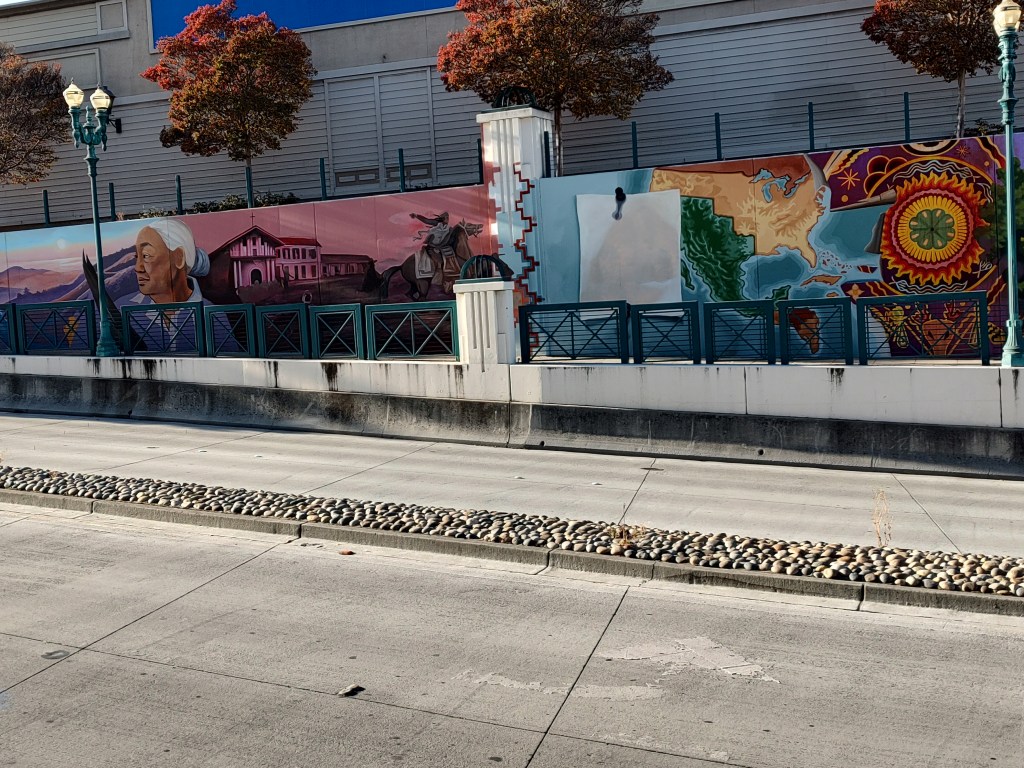
This first time meeting the muralist Rachel Wolfe-Goldsmith in person was almost an accident. Driving along the Jefferson Underpass in Redwood City, I noticed major progress on the Racial Equity Mural and felt a surge of pride at serving on the Steering Committee that conducted dozens of Zooms in the 18 months it took us to vet applicant artists, gather community input, and select and contract with Rachel.
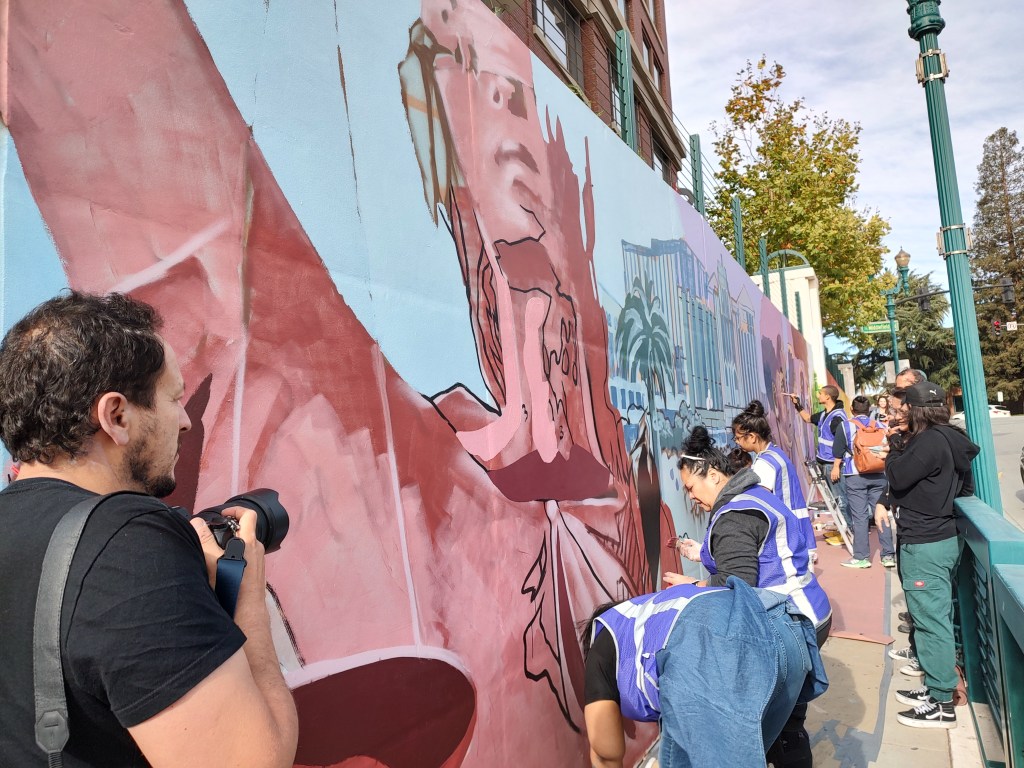
Then I noticed why the mural was taking such shape: Rachel in full swing on the underpass, working furiously, paintbrushes flying, in the throes of the passion that fuels her purpose. I pulled into the strip mall where her 4,700-square-foot wall ended and waved at her from behind the barrier.
She walked over, and I introduced myself, not expecting she would recognize or remember me from group Zooms with our committee. “I know who you are,” she said, laughing.
“The work looks amazing,” I said. “Obviously we liked your renderings, but to see this at larger- than-life-size instead of on a computer screen…I’m so glad we chose you to do this mural.”
“Me, too,” Rachel answered, laughing again. We talked process, planning, technique, and timing, all in just a few minutes. My steering committee work had landed me on a new Arts Advisory Work Group. I had to get to that first meeting I was driving to, and I did not want to keep Rachel from her work. The deeper, doper conversations about “race” — and all that means and all it doesn’t — would have to wait.
Again, we couldn’t talk long. Volunteers of all ages, sizes, and abilities arrived for their painting shifts and needed Rachel’s direction. Then there were the arts commissioners, the politicians, the press, and some random folks ignoring the barricades.
Rachel engaged anyone and everyone who wondered at her work. She somehow simultaneously kept painting, directing her crew, and graciously greeting and training volunteers. Despite the high-stakes possibility that an errant or misguided volunteer could ruin her work, Rachel placed her faith in even the least artistic people.
Community Paint Day energized this stretch of Redwood City. Drivers on the underpass honked and slowed their roll to take in the activity. People shot photos from across the street, where their cameras could capture panoramas of the mural and reveal its narrative arc, in contrast to what you could see while standing on the sidewalk right next to the mural.
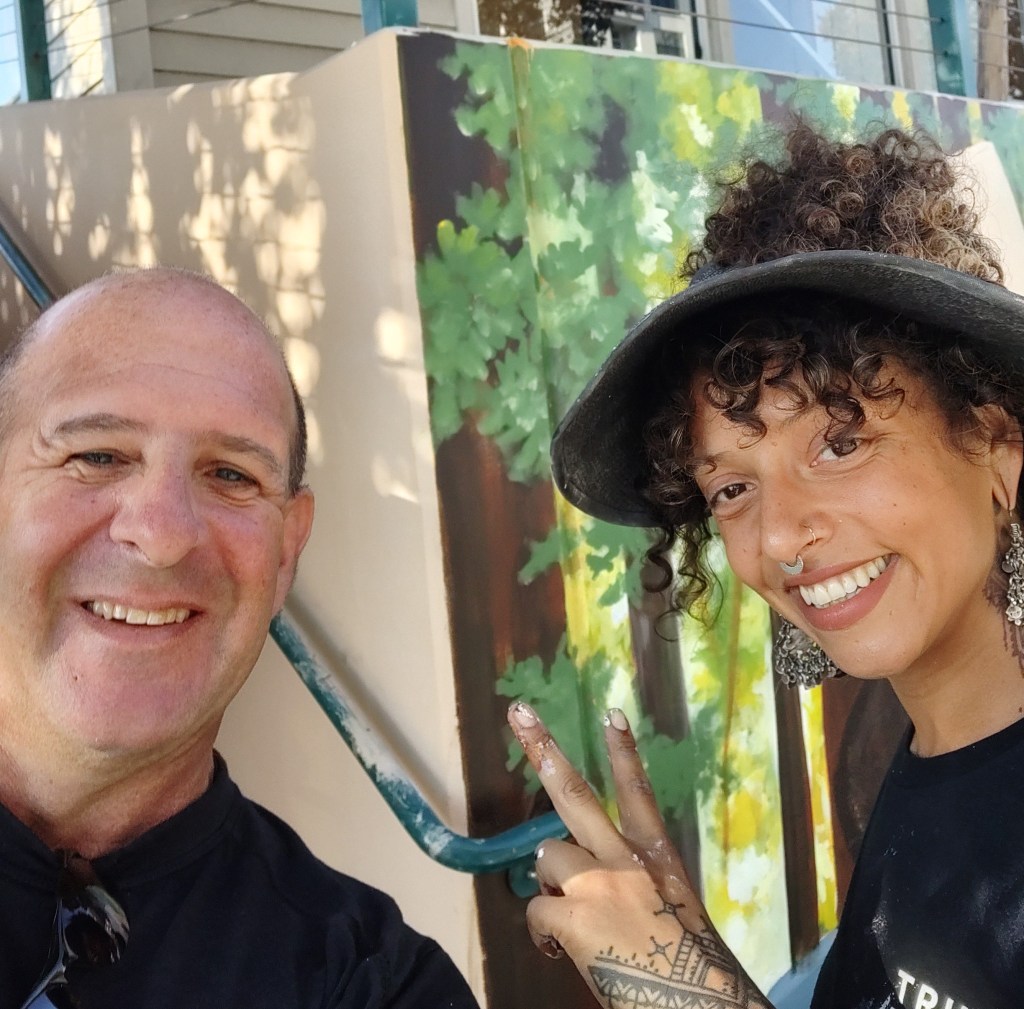
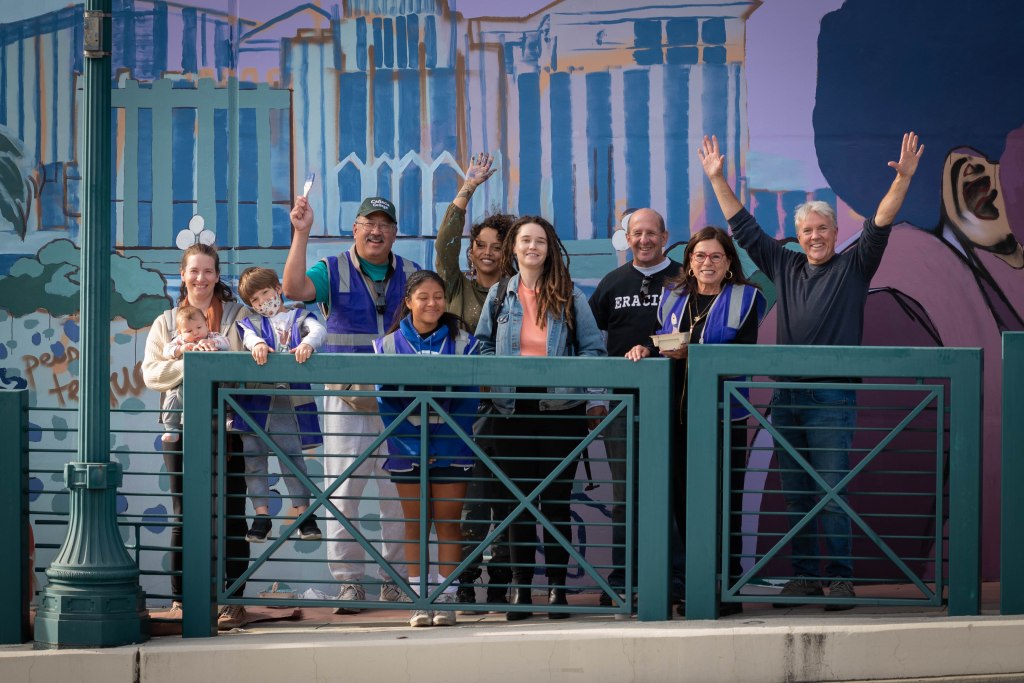
Everyone seemed joyous and united, rallying around this art. Just witness the triumphant looks on our faces in our team photo.
At the time, Community Paint Day felt like the culmination of a year-and-a-half of hard work conducted almost entirely via Zoom. But we reached an even higher peak a few weeks later, when the city held its official Racial Equity Mural Celebration.
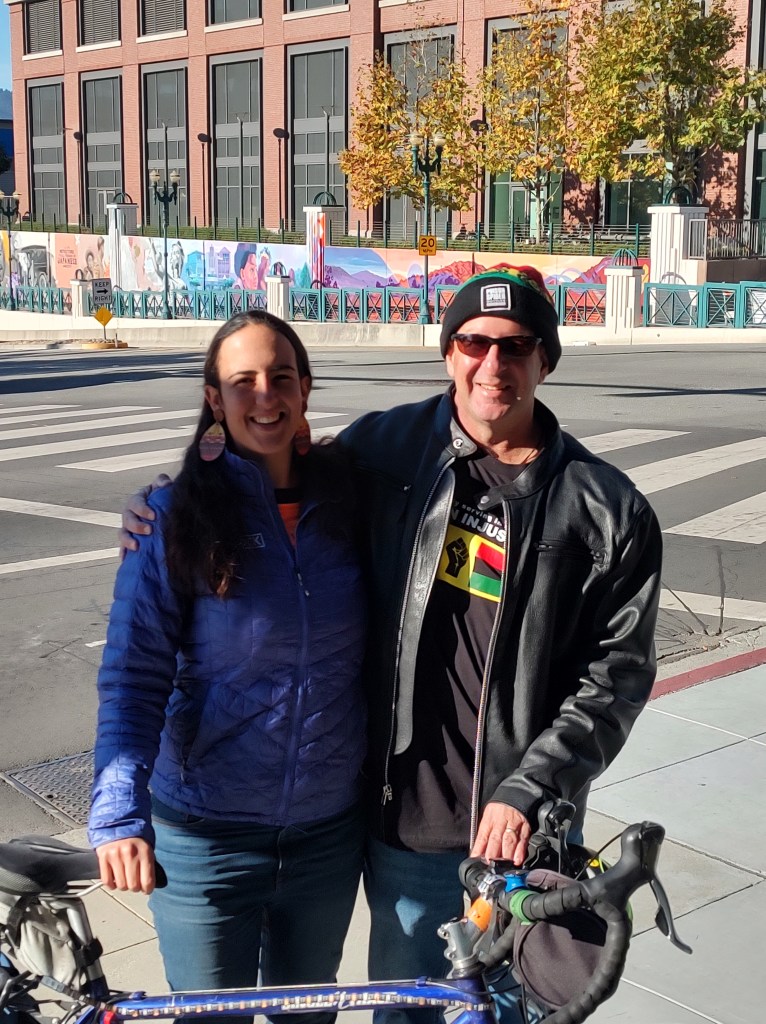
That event held extra meaning, because my daughter, Eleni, joined us. The site of our Celebration was just a block or so from the start of the group bike ride she was leading for Silicon Valley Bicycle Coalition. She met my committee colleagues, and we shared our mutual pride in a day of multi-generational social impact work.
The Celebration included public speeches that acknowledged the project originating as a response to the murder of George Floyd and whatever racial reckoning has followed. The event also was a chance to learn from Gregg Castro, representing the Ramaytush Ohlone, on whose land we were standing.
It was a chance to hear Rachel’s perspective, especially regarding the internal work entailed in seeking racial equity and social justice.
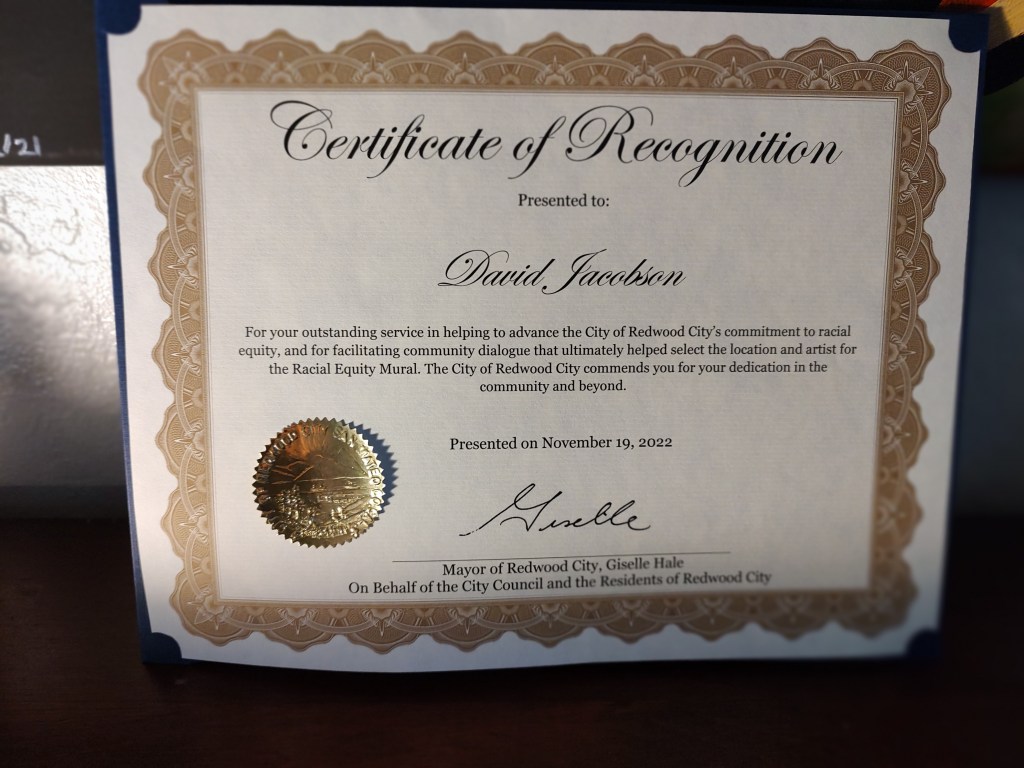
It was a chance to be publicly recognized for our work.
It was a chance to take a private tour of the mural, where Rachel led us further into her art.
It was a chance for meaningful multi-lateral private conversations that will inform our future work, individually and collectively, toward Racial Equity.
That was the day that Dusty Baker, who managed the Houston Astros to a World Series win tonight, received Positive Coaching Alliance’s Lifetime Achievement Award. I asked Dusty for a photo together, and Willie Gault, star receiver for the 1986 Super Bowl Champion Chicago Bears, came over from my left and said, “We gonna make an Oreo out of you.”
It was always a good time with Dusty. Just a few minutes earlier that day, Dusty and I talked about his tour of Apple Computer headquarters at One Infinite Loop, which he called an architectural marvel. As a Cubs fan, I told him he’d already seen the most marvelous architectural wonder in the world. He thought about it for a few seconds and asked, “Which one is that?”
“Wrigley Field,” I responded, and in less than a few seconds, he said, “Aww, man, that place is a dump!”
At a different Positive Coaching Alliance event, where we first met, he was coming off surgery and hobbled through the lunch line on his cane, a beautiful knotted dark hardwood adorned with feathers and other talismans that lent him a mystical air. In a private room at the Stanford Faculty Club, he told tales of his time in the minor leagues in the South of the late ’60s, post-Jim Crow by letter of the law, but not its spirit.
Somehow, in that room of 20 or so souls, with conversation gravitating to counter-cultural sports icons, Dusty mentioned the legendary football player, Joe Don Looney and asked if anyone knew his story.
“He was an outstanding bar fighter,” I answered. “Yes,” Dusty confirmed, “One of the best.”
“I think he also decked Bud Wilkinson at Oklahoma,” I added.
“One of his assistants,” Dusty corrected.
It all went to building rapport that stretched over a few video shoots we did together for Positive Coaching Alliance. Here is my favorite clip, mixing the fun and seriousness Dusty brought to his work, which finally resulted in tonight’s World Series win.
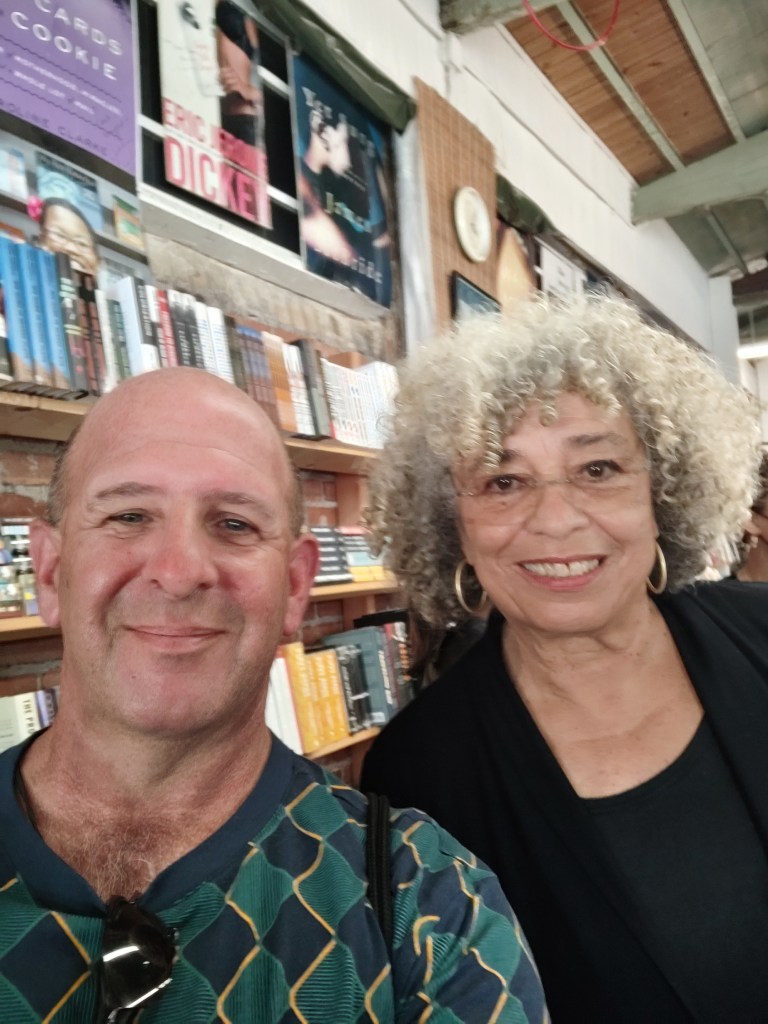
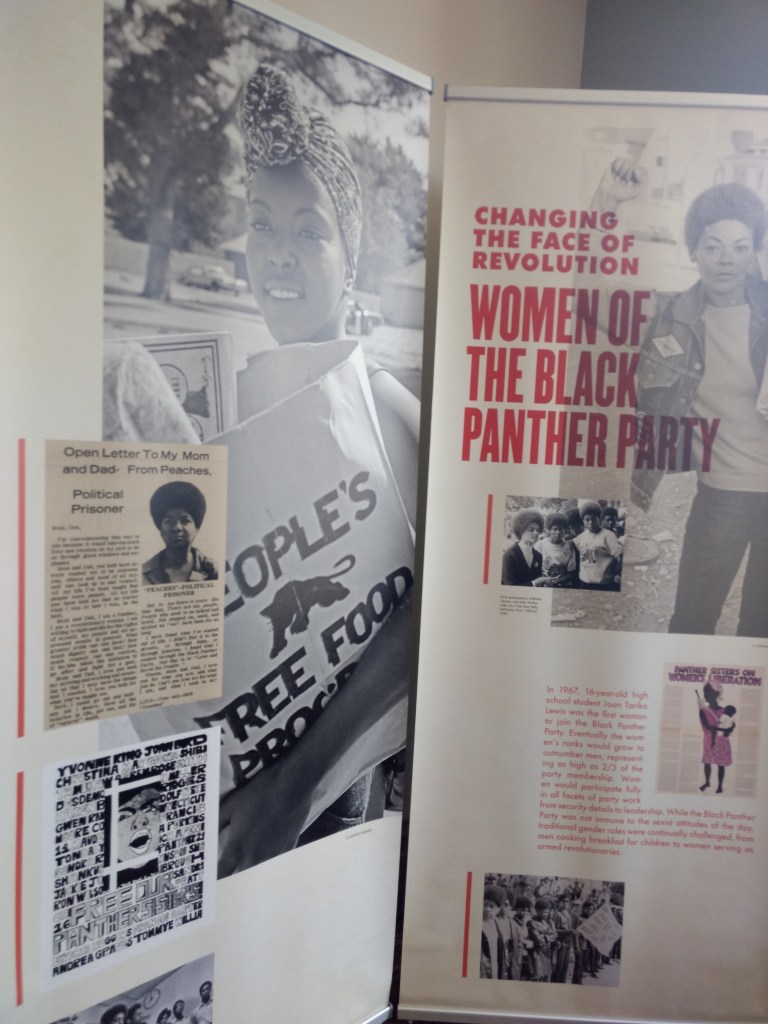
Yeah, that’s Angela Davis, and I am glad to finally scratch that meeting off of my bucket list. Word of the opportunity arrived from @marcus.books, which hosted her and other contributors to the new book Comrade Sisters: Women of the Black Panther Party for presentations, conversations, and book signings.
Arriving 20 minutes early, I stood at the end of a block-long line that eased into the bookstore’s cozy confines. Maybe 200 or 300 folks packed the place for Marcus Books’ first in-store event since the pandemic started.
Speakers included:
Blanche Richardson, owner of Marcus Books, the nation’s oldest Black-owned bookstore, whom I met while working on At the Cookout
The author of Comrade Sisters, Ericka Huggins, a prominent Panther, whose husband, John, was assassinated in 1969 in a plot allegedly hatched by the FBI’s COINTELPRO
The book’s photographer, Stephen Shames
Several women of the Black Panther Party on a panel that Angela Davis moderated.
Each speech inspired more than the one before. Angela Davis told the story of an illiterate 14-year-old boy, who grew so enamored of John Huggins’ leadership that he borrowed books and a dictionary and taught himself how to read in order to improve his effectiveness in the movement. Off to the side, whenever so moved, an old man leaned on his cane and muttered through his mask, “Power to the People.”
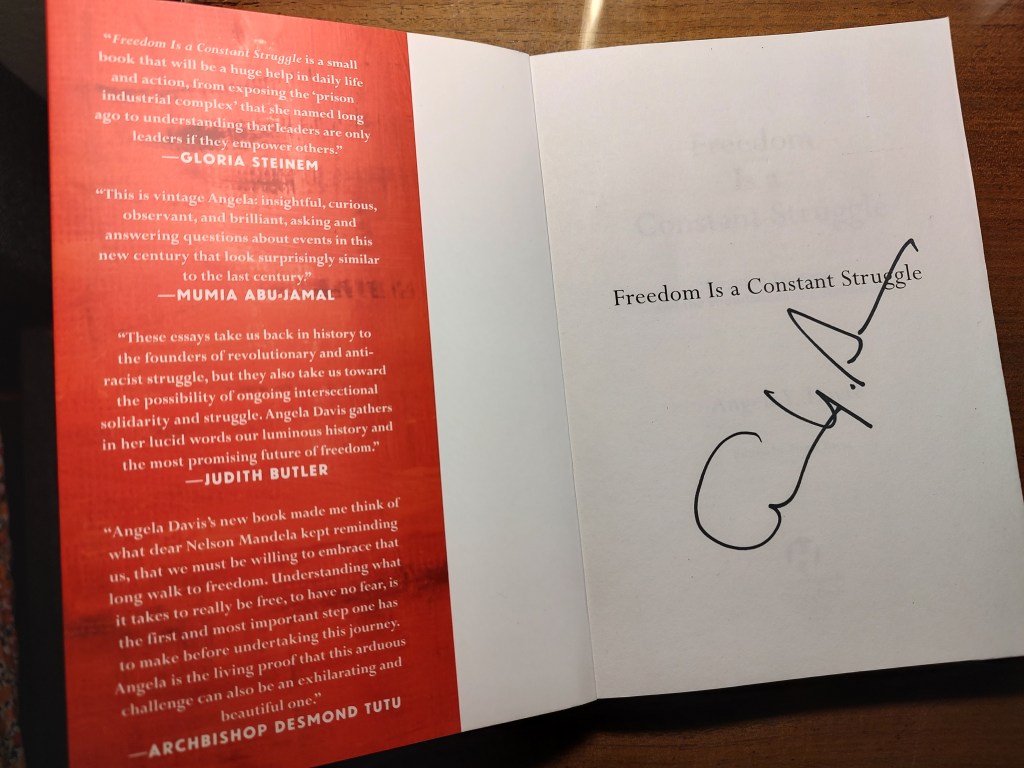
In-between, there were personal reunions, handshakes, hugs, back-slaps and shouts. Blanche ran out of copies of Comrade Sisters to be sold and signed. Fortunately, I’d brought my dog-eared copy of Freedom Is a Constant Struggle, so I stood in line for an hour after the presentations until it was my turn for Angela Davis to sign.
Like most book signings, it was hurried, without enough time to tell the author exactly how the work moved you. Like all book signings, sharing any space and time with an author who moves you to stand in line leaves you feeling you’ve stood with greatness.
The next day, Jilchristina Vest hosted another signing for Comrade Sisters at her home, which houses the Women of the Black Panther Party Mural and Museum. Arriving even earlier than the day before, I had a chance to catch up with Jil on our work, help her set up for the event, and give her one of Brandy’s candles that I wrote about in At The Cookout.
Held outdoors as a block party with food and a DJ, Jil’s event brought the book’s author and photographer together with even more of the women of the Black Panther Party. My favorite presentations, featured below, came from Cheryl Dawson, Ericka Huggins, and the Oakland School for the Arts.
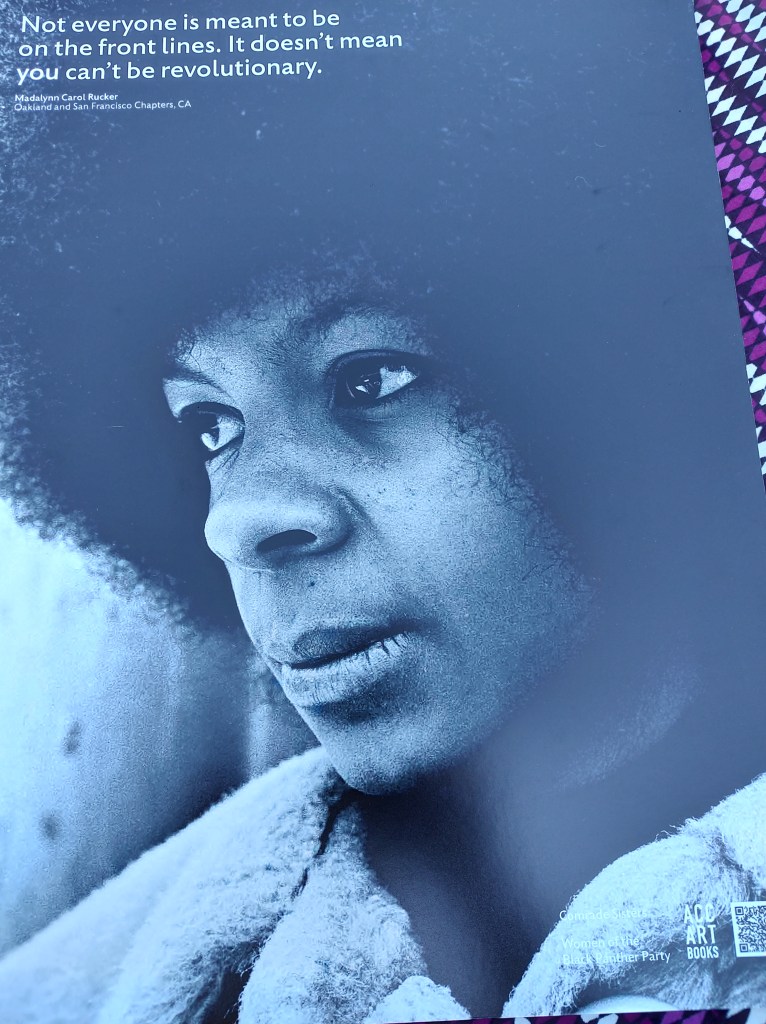
In the picture above, Ericka holds one of the posters that Jil had left out on tables for the public to ponder. Its message holds particular meaning for me as a writer and reminds me to aspire to more.
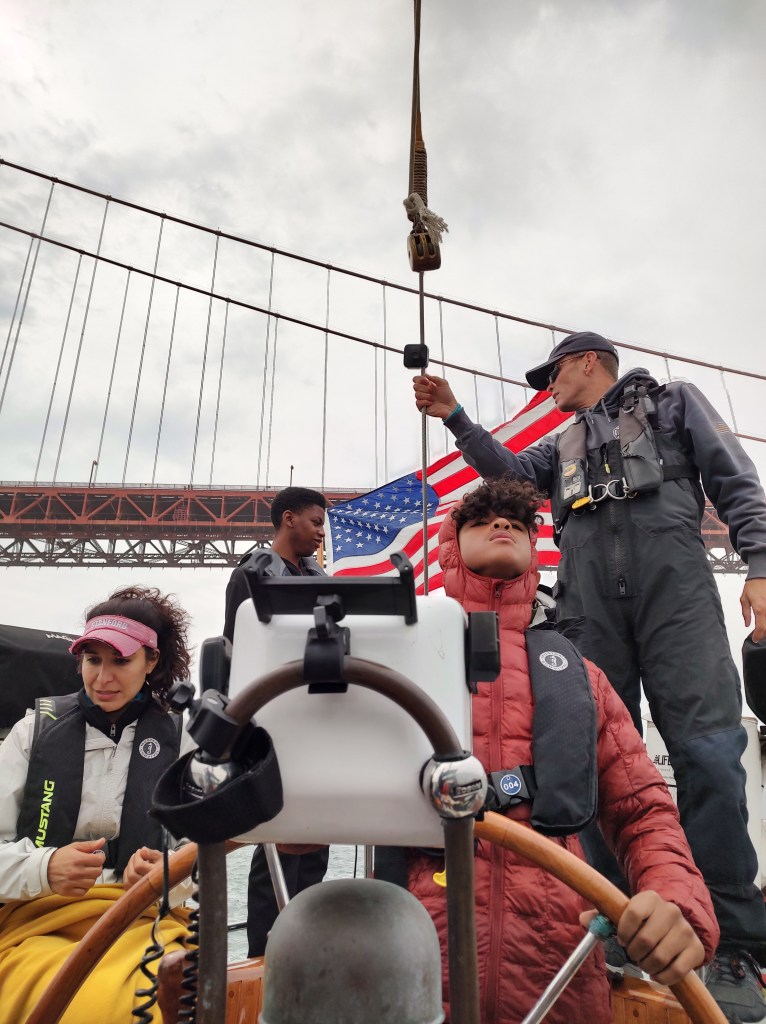
When Eric Jones, captain of Sea Valor, handed me that flag behind us to place in the flag holder yesterday, my first thought was “don’t drop it into the Bay.” The American flag means more to Eric than it does to many of us.
Eric’s story came to me from Tony Green a few weeks ago, as I sat across Tony’s desk at Bishop O’Dowd High School in Oakland learning about his pioneering work with the new AP African-American History course. Tony invited me to join his group aboard Sea Valor, where Eric, Tony’s former student, would contribute to the course curriculum.
An invitation for a day sailing on the Bay is a no-brainer, but that invite grew dear to my heart when Tony told me Eric’s story, adapted here from http://www.SeaValor.org:
Eric grew up in the Bay Area, his mother a social worker, and his father an Air Force Colonel. Eric felt compelled to help people from an early age and became an EMT as soon as he turned 18. That led to him joining the Prince George’s County Fire Department, where he received additional training in firefighting, search and rescue, hazardous materials, and rescue diving. Eric continued by earning his Paramedic certification, and in 1998 graduated from The George Washington University (GWU) with a BS in Health Sciences, with a focus on Emergency Medical Services with a minor in Psychology.
On the morning of September 11, 2001 Eric was driving to class at GWU (he was then working towards a Masters in Public Health), and as he neared the Pentagon, American Airlines flight 77 had just crashed into the Pentagon. Knowing he had the skills to help, he pulled over and ran towards the building. He helped pull and carry five people from the impact zone, and then spent the next four days as a member of the Mortuary Affairs team removing the remains of those killed. On September 14, Eric finally left the Pentagon, and drove to New York Ground Zero, to join fellow members of his fire department who were already there assisting with the massive search and rescue operations. He spent another two weeks engaged in search and rescue, and then search and recovery operations. For his efforts, Eric was one of two people awarded the Medal of Valor from the Department of Defense, the highest civilian award issued for heroism.
Like many of the first responders during 9/11, Eric has struggled with PTSD, and additional traumatic events over the years have made it worse. He has tried all of the traditional treatment methods; therapy, medications, support groups, etc., and found varying degrees of success, however nothing has “cured” the depression and PTSD.
Over the years, Eric has known seven people who have taken their lives as a result of their depression and PTSD. In 2016, his friend Jason, an honorably discharged and highly decorated Army sniper, took his own life. Just a few months later, his friend Andrew Berands, an Oscar-winning cameraman, took his life. Both of these tragic deaths affected Eric very hard. He has known firsthand the deep feelings of hopelessness and despair that result from the inability to process traumatic events. Eric’s fate might have been the same, but believes that sailing and a love for the ocean saved his life.
Eric has always loved all things ocean; scuba diving, swimming, boating, exploring tidepools, but in 2010 he discovered sailing. First, on small sailing dinghies in the Potomac River, then on larger boats which ventured offshore. In 2011 Eric served as crew on his friend’s boat sailing from Miami, Florida to Annapolis, MD. This experience solidified his love for sailing.
For a week, as they cruised up the Eastern Seaboard, Eric felt happy for the first time since before 9/11. His depression was still there, but sailing and being surrounded by the ocean and all of its beauty, brought him a sense of peace that he had been yearning for. This was the first time he realized the healing power of sailing and the sea.
Over the next several years, Eric’s depression grew worse. After his mother died in 2015, followed by the suicides of his two friends, Eric was in a bad emotional state. The only time he felt calm and at peace was when he was near or in the ocean. He started sailing with friends, and over time, he realized that he felt better not only on the days that he sailed, but on the days before and after. Sailing and other ocean activities were helping. Eric founded Sea Valor to bring the same healing to others suffering from PTSD.
Yesterday, I joined Tony, a diverse group of his students, and a few other strays like myself at the Emeryville Marina, where Sea Valor is moored. I asked Tony how Eric might be feeling on the eve of the 21st anniversary of the 9/11 attacks. He said that we may or may not hear from Eric about that, and he reminded me to check out the display below deck of the triangular-folded flag that Eric rescued from his days of service at the Pentagon.
Waiting in the parking lot as Eric and his crew prepared, Tony completed the class’ unit on “The Global Reach of the Mali Empire,” dropping knowledge and calling on students to contribute what they’d learned in his classroom, including the voyage of King Abubakari II, ruler of the Mali Empire, who in 1311 AD, led an African exploration to the New World, sending out 200 ships of men, and 200 ships of trade material, crops, animals, cloth, and African understanding of astronomy, religion and the arts.
Soon after boarding, Eric’s father, a retired Air Force colonel, gave a brief presentation on African-American contributions to our country and gave us each a newly minted quarter commemorating the Tuskegee Airmen. That set the tone for our voyage, mixing education, a celebration of Black excellence, inter-racial exploration, and the co-operation that sailing requires.
Eric put us under engine power until we cleared the Berkeley Pier. Students helped raise and lower sails and took turns at the wheel under direction of Eric and his crew–Heather and Nixon. We tied up at Angel Island, the “Ellis Island of the West,” where many Asian immigrants started their American adventure. There, Eric presented to the students about the technical aspects of currents and navigation, introducing a STEM element to Tony’s teaching and helping students understand what confronted both King Abubakari II and then 300 years later, those who endured the Middle Passage.
From Angel Island, we sailed toward and under the Golden Gate Bridge.
Then we skirted Alcatraz Island, where Tony and our new friend, Wanda, kept conversation real as we drifted past reminders of some other real Americans.
Eric kept us on the water for about five magical hours. Although we never heard from Eric about his trauma, many of us shared stories of our own. Wanda and I compared notes on the Black and Jewish experiences as both friends and foes in this country. Nixon, of Asian descent, explained that his father named him after the former President, dooming him to not only persistent questions about the origin of his name, but also being playground nicknamed “Tricky Dick.”
Exhausted and exhilarated, we arrived back at Emeryville, processing thoughts and feelings that arose from our conversations, none about how to make America great again, most about how to make America America again.
(New book available here, as seen on American Ninja Warrior, with a portion of proceeds benefiting Barbara Sinatra Children’s Center in its fight against child abuse.)
When the July 18 episode of American Ninja Warrior featured The Man Behind the Mask – a book I crafted in collaboration with Flip Rodriguez and Noah Kaufman – I felt like I’d “beat that wall” and hit the buzzer. Pardon my slip into Ninja-speak here. It’s what I had to do to land the book gig in the first place.
Skeptical of a reality-TV sport, I initially resisted an introduction to these Ninjas. I soon knew they spoke my language, and I soon started speaking theirs. Therein lies the first of several lessons I learned en route to the making of The Man Behind the Mask, shared here to help other entrepreneurs, especially in the creative fields.
That first lesson: Listen.
Listen Amy Manson, a colleague when I led marketing communications at Positive Coaching Alliance, asked me to explore partnership with a group called Wolfpack Ninjas. She offered to connect me with the group’s leader, Noah Kaufman, the physician who starred on American Ninja Warrior as “The Ninjadoc.”
Accustomed to partnership with Hall of Fame athletes, coaches and teams from the major pro sports leagues, hearing a name that sounded more like a WWE character stopped me cold. As the saying goes, “Nevertheless, she persisted.”
I relented when Amy explained that the Wolfpack Ninjas were “making the world healthier one kid at a time,” and Noah practically had me at hello. Within minutes we found that we hailed from neighboring suburbs outside of Chicago and that his group and ours both focused on youth-friendly principles of sports and educational psychology.
Noah said he could demonstrate this via video he would send me. Most such promises from other partnership prospects over the years were never kept. But when Noah’s video arrived the next day, I was glad I listened to Amy and glad I listened to Noah.
His well-produced minute-long cellphone video featured him speaking in voice-over shots of his son repeatedly failing to scale a Warped Wall until he finally succeeded. Noah’s video nailed our PCA principles. When I asked how he’d done such a good job so quickly, Noah said, without irony, “I’m a Ninja.”
Throughout that partnership, we discovered similar values and skill sets, often finding the other answering emails at 2 a.m. While co-promoting and attending Wolfpack Ninjas events, I connected with many of Noah’s team of about 30 Ninjas. But that phase of our work abruptly ended when PCA laid me off in August 2017, leading to the next lesson in the making of The Man Behind the Mask.
Say Yes Phoning Noah to explain my departure, he thanked me and said, “This layoff must be sad for you, so I don’t want to seem overly opportunistic, but would you consider contracting with us?” I answered, “Thanks. It is sad for me, and I also don’t want to seem overly opportunistic, but honestly, that’s part of why I’m calling. So, yes.”
Over the next two-plus years, our group worked hard, traveled together, stayed up late, and sweated out mission-critical assignments, quite literally, in the case of a playground build with KABOOM! on a 95-degree day in San Antonio. We forged the sort of bonds that uniquely arise from those circumstances.
The rewards of friendship, achievement, and adopting the mindset of these world-class athletes made me happy I’d said, “Yes,” especially because our San Antonio team included Flip Rodriguez, who is The Man Behind the Mask. One other reward was learning more lessons.
Sometimes Work for Free The pandemic halted our live events. Noah’s financial backers ended our contract. With their blessing I contacted the Ninjas individually and landed a couple sweat-equity-only gigs.
Though I never saw cent one, I enjoyed the work and continued growing, which reinforced the lesson to “Say Yes.” I have no doubt that is why Noah contacted me late in 2021 with an offer of paid work on The Man Behind the Mask, a process that taught me one more lesson.
Play to Your Strengths, and Help Your Collaborators Do the Same Noah Kaufman knows business. He runs it for our collaboration. Flip and I stay out of the way.
Another of Noah’s strengths is that he knew Flip well enough to help him open up in the eight hours of conversation they recorded for the core of the book. Flip’s story is so agonizing that he sometimes had to stop talking, and Noah, The Ninjadoc, masterfully supported and encouraged Flip as he would any trauma patient in the ER.
Flip’s strength is his honesty and courage. It’s not fearlessness. It’s his ability to overcome fear. That he endured his trauma is evidence. That he purposefully re-lived his trauma in the telling of his story shows the strength of his conviction to “get comfortable being uncomfortable” and the depth of his commitment.
Me, I know words. I edited theirs into a coherent narrative, wrote the book’s afterword, and this marketing copy for our Amazon page: “Read the real and raw story of Flip Rodriguez, the ‘Man Behind the Mask.’ In this inspirational story, the American Ninja Warrior star explains how he overcame years of sexual abuse during his childhood and lifted himself from the depths of despair to unimaginable heights.”
Walter “Sweetness” Payton (pictured on my shirt) famously ran hills in the heat, first on a sandbank of the Pearl River outside his hometown of Columbia, MS and later on the landfill in Arlington Heights, IL now known as “Payton’s Hill.” As part of the sports and fitness fantasies sustaining me for nearly 58 years, I draw inspiration from trying to replicate my heroes’ feats, albeit with age-and-ability-appropriate modifications.
So, on the hottest day of the year, I wear Walter to the local landfill at Seal Point Park to run my own version of his workout. Sweetness called his hill “The Widow-Maker.” I call mine “Motherfucker.”
On the dirt trails up from the parking lot and/or the stairs cut into the bay side of the hill, the workout is sprint up (about 30 seconds) walk down (about 90 seconds) x 10. On a good day, allowing for a few extra steps at the end of each lap, I finish that HIIT (high-intensity interval training) workout in 23 minutes.
Spotify plays my Run list from the phone in my pocket. Other distractions from the pain include pelicans gliding low above the bay, the rare hare bounding along the trails, and even a snake slithering across my path.
Then there is the human wildlife, the regulars who inhabit the hill, all given secret nicknames for their attire, their physique, or their other bodily adornments. On any given day there’s Beanie, Lefty, Sideboob, Osama, Chihuahua, and Ab-Tats.
To keep myself going on those 10 laps, self-talk:
1. “Get one done.” 2. “That’s two for you.” 3. “Feeling it now.” 4. “Starting to sweat.” 5. “Halfway.” 6. “More than halfway.” 7. “Just three more.” 8. “There’s that one-mile buzz on my smartwatch.” 9. “I can’t breathe.” 10. “Come on, Motherfucker.”
In that last one, I address both the hill and myself as opponents. Throughout my “athletic” career, that 12-letter word has always issued challenge. It’s the gauntlet thrown by pick-up basketball foes and anyone ready to fight or at least find out if you’re ready to fight.
Like Sweetness, every day that I run hills in the heat, yes, I am ready to fight, at least against myself.
After dark on May 2, D.C. wasn’t overly hot, walking from my de facto headquarters at The Hamilton back to Hotel Harrington. The night held just a hint of humidity, a soft blanket that subtly alluded to the city’s notorious sweat soakings.
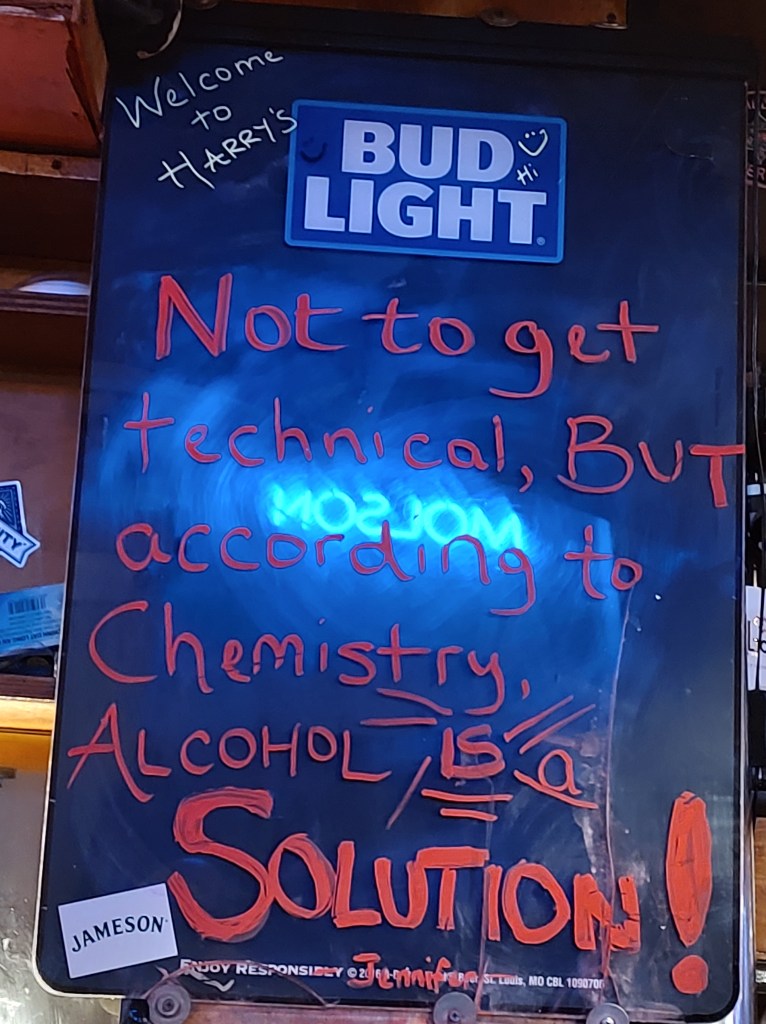
Nothing even happening at Harry’s, the often-rowdy dive bar in the Harrington, which is a dive hotel like the one where Robert Blake and Tom Ewell lived in the old Baretta TV series. But it’s worth staying there for the old-school “charm” at half the price of anywhere else such a short walk from the White House and even more importantly The Hamilton.
But up in my room, where the blackout drapes almost met closely enough to keep the light out, CNN let me know we’d feel heat the next day. The news broke about the Supreme Court’s draft opinion re: Roe v. Wade.
Sleep with CNN spicing my dreams segued into waking surrealism. The candidate’s team communications platform overflowed with internal messages, mostly of the wailing-and-gnashing-of-teeth variety. I would have to directly phone the candidate back in Houston to sort this out.
And it would have to happen while walking to the day’s destinations, familiar haunts from my past D.C. visits. I refused to forego the pilgrimages I’d planned on top of a two-day out-and-back from San Francisco to D.C. built around representing my client, Fit Kids, at the Aspen Institute’s Project Play Summit.
The call came at 10 a.m. from the candidate — Cameron “Coach Cam” Campbell, known for the #GridironGrit he brings from his football coaching career to his campaign to “go to state” as the representative for Texas House District 132. Yes, in Texas, it takes nothing less than #GridironGrit grit for a Black man to turn a red seat blue.
Between Coach Cam’s infant and toddler in his office and the street shouts and sirens that started to wane when I walked the gentrified U Street Corridor, we somehow managed to mostly understand each other. I would duck into Busboys and Poets, the progressive bookstore/cafe, for inspiration…
…and I would take my findings — which this time included The Trayvon Generation by Elizabeth Alexander and Create Dangerously: The Power and Responsibility of the Artist by Albert Camus — to a proper office to compose a statement on SCOTUS for Coach Cam’s consideration.
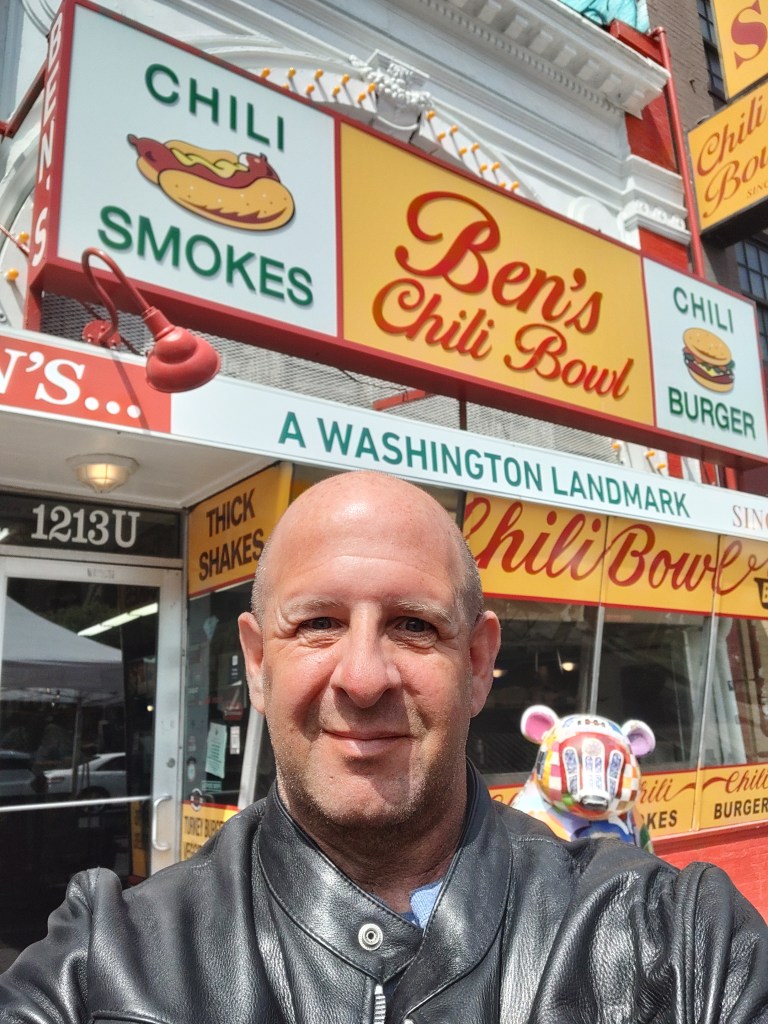
In my booth at Ben’s, fueled by the vibe and an Original Chili Half Smoke, I wrote: The Supreme Court opinion that came out yesterday demonstrates the vast overreach and ruthless power grab of the political right, reaching right down into the most intimate and personal aspects of women’s lives. The right, embodied by the Republican Party, does this against the will of the people they are sworn to represent. It is up to us as individuals — politicians and constituents alike, starting at the local level — to use our voice and our vote to protect our legal rights. The Supreme Court stands poised to trigger the worst of what Texas Republicans already have decided. Our best defense against the violation of our civil rights and human rights is to remove Republicans from power, and I intend do so in HD 132.
With Coach Cam more or less signed off on that, a long, hot walk had me hit the Smithsonian’s National Museum of the American Indian an hour before closing. On the way there, and then to happy hour at Off the Record in the famous Hay-Adams Hotel, glimpses of the Washington Monument, the U.S. Capitol, and the White House had me feeling some type of way.
The sight of the buildings themselves are so iconic, so burned into my brain as a patriot-in-training from earliest memory, that they raise a reverence. But knowing what their residents and honorees perpetrated is just as breath-taking.
Sitting in Off the Record — elbow-to-elbow crowd clamor drowning out CNN’s continuing coverage of the not-yet-24-hour-old SCOTUS news — I wondered who around me shaped policy in which ways. In those surroundings, politics feel real.
It was nothing a stop at headquarters couldn’t cure. So I walked back out into higher heat and humidity than the night before.
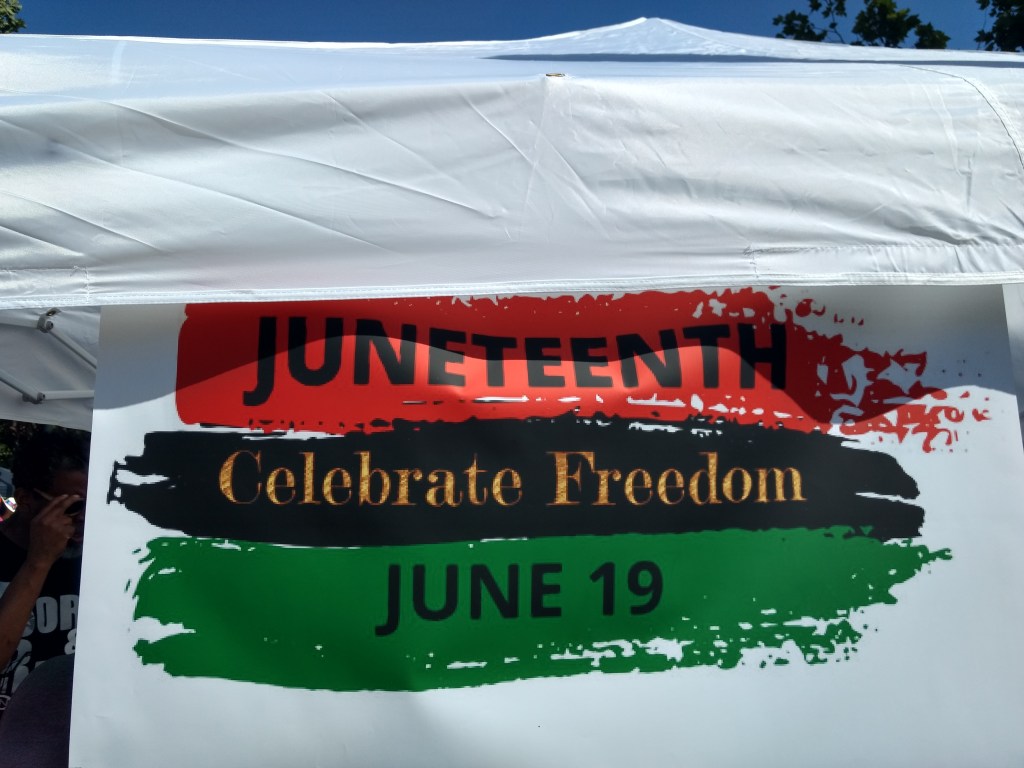
About 20 years ago, I consulted to Clifford Robinson, founder of Juneteenth.com. So, when June 19th suddenly became a federal holiday, I was happy for Clifford. I was happy for anyone who felt “seen” or “centered” or “redeemed” or “triumphant.”
But I was also feeling some type of way. I didn’t quite know why until I saw this:
We asked for extensive voting rights protections, defunded police depts w/resources reallocated to education, job training & other essential &underfunded areas, criminal justice system overhaul and reparations.
And what did White folks do instead? Gave themselves a day off work.
— Candice Marie Benbow (@CandiceBenbow) June 16, 2021
@CandiceBenbow nailed it.
Still, I wanted to know first-hand if the Juneteenth vibe felt any different now that the holiday had gained white recognition. So, I headed to Oakland for the afternoon.
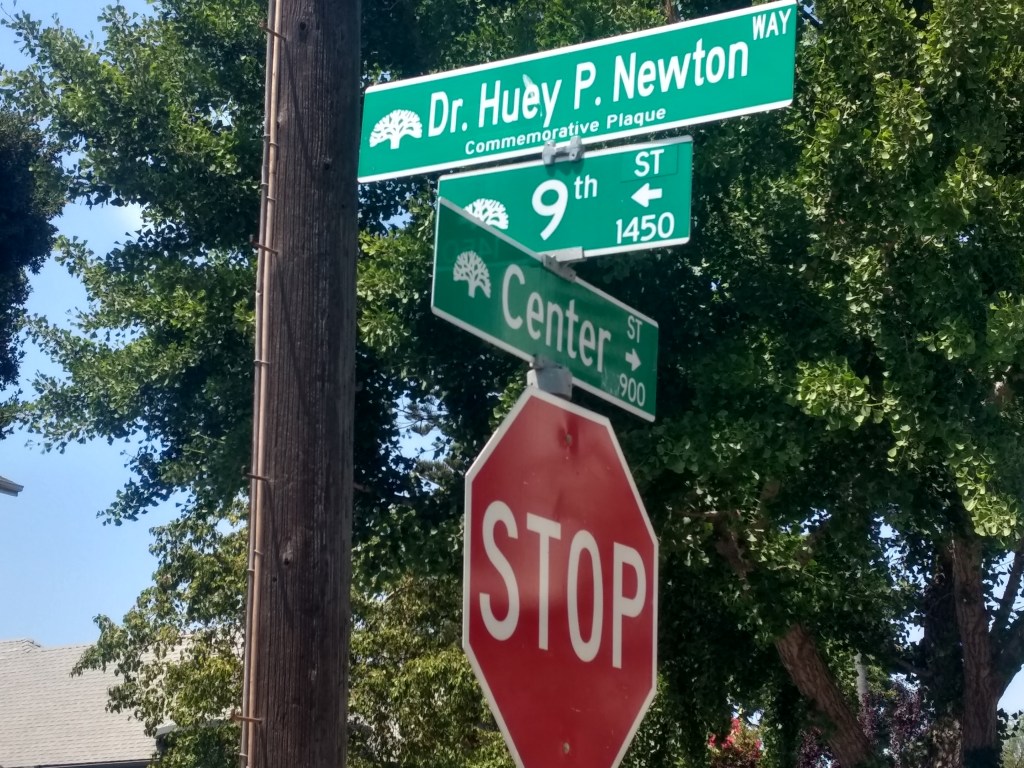
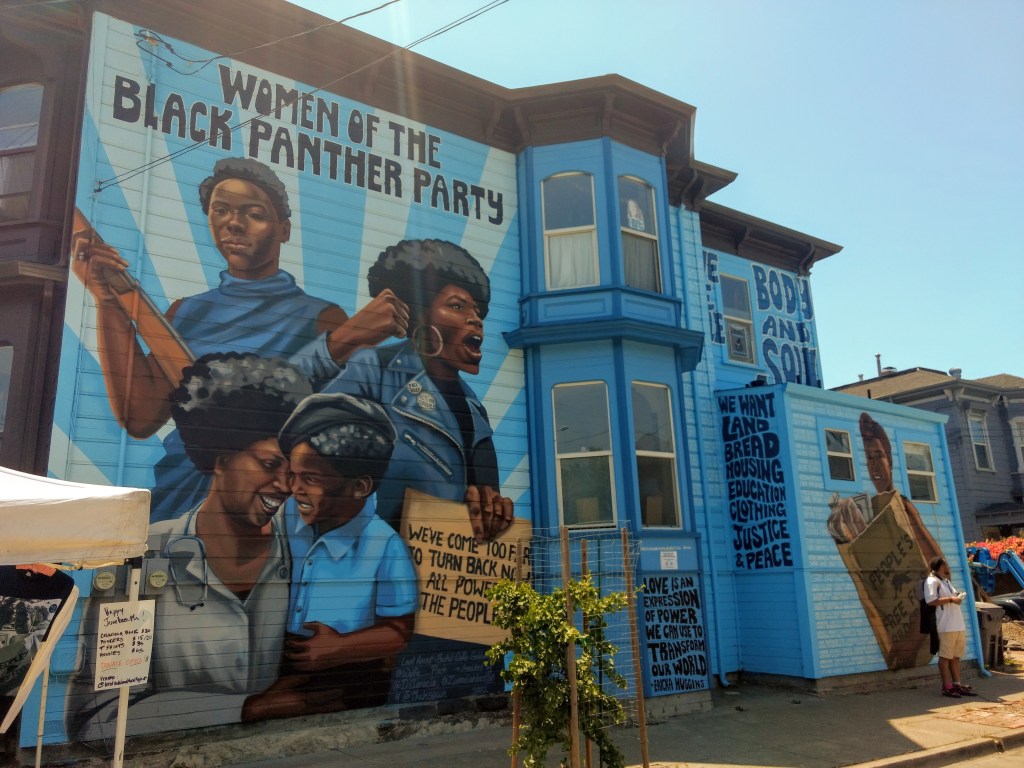
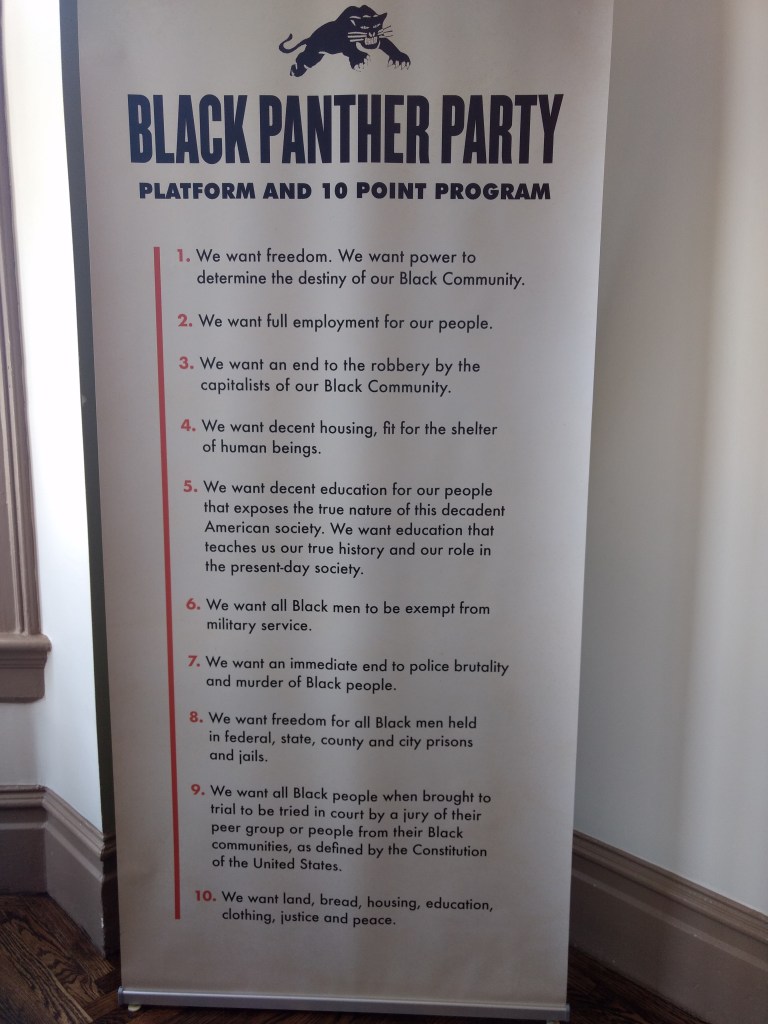
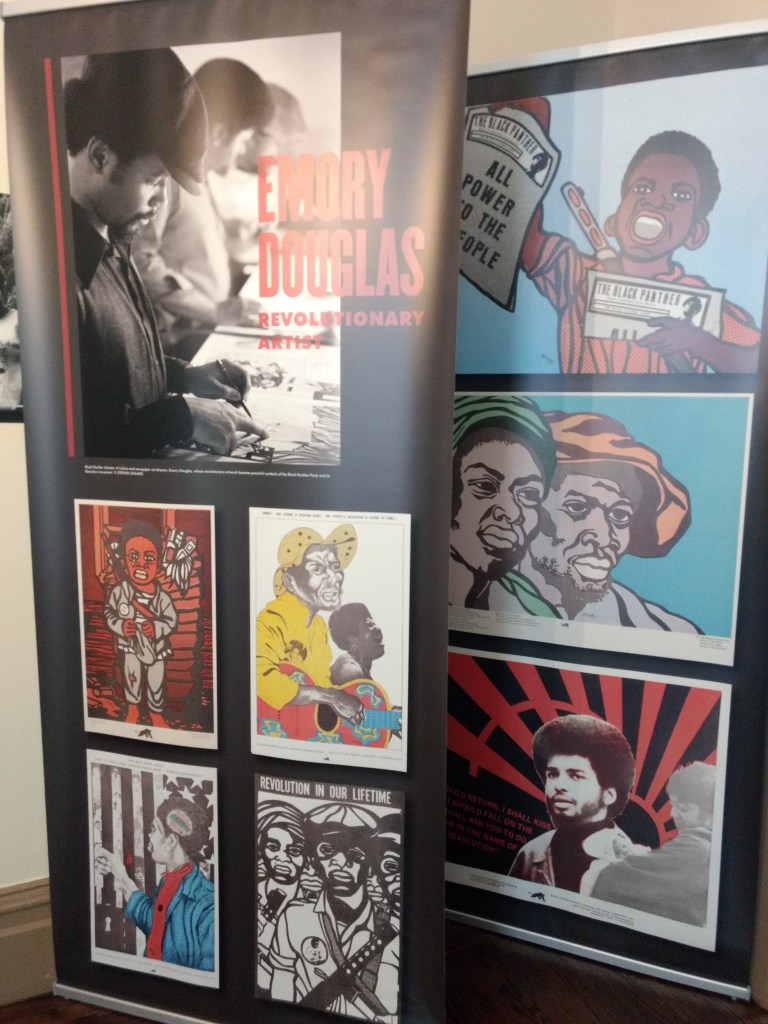
First stop was the home of Jilchristina Vest at the corner of Center St. and Dr. Huey P. Newton Way, painted on one side with a mural of the women of the Black Panther Party and its first floor converted into the just-opened Black Panther Party Mini-Museum@The Mural.
That event was festive and low-key. A block party featured a DJ, a food truck, and horseback rides. It was a 15-minute wait to get into the museum, which at 1,000 square feet, and still in pandemic days, accommodates just seven or eight people at a time.
I was glad to Venmo the suggested $15 donation on my way in, and even happier I had done so on the way out. Some of the sights seen:
Jil asked us to limit our museum time to 30 minutes. I could have stayed longer, not that there was a lot more content to consume, but because the space echoed with what the Panthers meant to their community. Before leaving, I chatted briefly with Jil and signed her guestbook.
Next stop was the official Juneteenth celebration at Lake Merritt Amphitheatre. I never made it. Traffic and parking was so prohibitive that I parked a mile and a half away and walked downhill to the lake. I passed a UPS truck blaring “What’s a Telephone Bill?”
“Hey, man!” I yelled over the bass. “I am loving that Bootsy!” Dreads in the brown uni lugging a package across the street fired me a raised fist.
When I hit Grand Avenue, the exhaled smoke scent thickened. So did the sidewalk traffic and roar of backfiring motorcycles and 808s booming out of cherry ’64s.
I took a lap through and around the vendor tents near the Lake Merritt Pergola. I saw scant sign of Juneteenth or its historical significance. Instead, I saw this.
My other obligations that Saturday kept me from staying. Maybe that’s a good thing because two hours later and two blocks away:
So, by Sunday morning, I had my answer. “Official” Juneteenth celebration vibe may have changed. Otherwise, same old shit.