Riding the Riverwest 24: Comments on Community and My First Tattoo

Image

It took Molly a couple years to convince me to ride in the Riverwest 24 Hour Bike Race. Sitting on her balcony in the twilight over our glasses of red wine, Molly always made the event sound appealing for its sense of community and the unique twist of a tattoo that many riders get to commemorate their participation — a grittier, gutsier step beyond “been there, done that, got the t-shirt.”

The more Molly talked about the ride through the Riverwest neighborhood of Milwaukee, the more it sounded like a dare, the mix of athletic challenge and encouragement we’d shared since high school. But now we were 60, and the prospect of bicycling for 24 hours and getting a tattoo seemed absurd.

“You don’t necessarily ride the whole 24 hours,” Molly explained. “You get off the bike for checkpoints, where you can drink a beer or have a community experience in one of the shops or in people’s homes. Some people sleep or trade off shifts with their teammates. It’s not competitive.

“And, you don’t have to get the tattoo” she said with a smile that looked more 16 than 60. “But you know you want to.”

OK. Sold. Which is how we got here.

At the start just in front of Molly, backed by (L. to R.) Maureen, Carol, Brenda, and Colleen, members of Team Millio Zillio.

In the seconds before the 7 p.m. start of the Riverwest 24 on July 26, 2024, roughly 1,800 registered riders are a mass of nervous energy, ringing bells to signal they’re ready to roll.

At the start, cyclists surge forward. Then they stop. The crowd condenses. Sardined in the street with at least 1,800 riders of various ages, abilities, and levels of patience and competitiveness, it suddenly seemed a lot could go wrong. Less than a week after Milwaukee hosted the Republican National Convention, hair trigger tempers remained as hot as the air temperature.

Plus, the Riverwest 24 coincided with the Milwaukee Air & Water Show, featuring the U.S. Air Force Thunderbirds, and the Harley-Davidson Homecoming, bringing thousands of riders new to Milwaukee’s streets, who were bound to be frustrated by bicycle traffic. The threat and promise of sonic booms and backfires jangled nerves.

With scant police presence assigned to our ride, our community would police itself. Fortunately, Riverwest 24 organizers guided us with simple reminders.
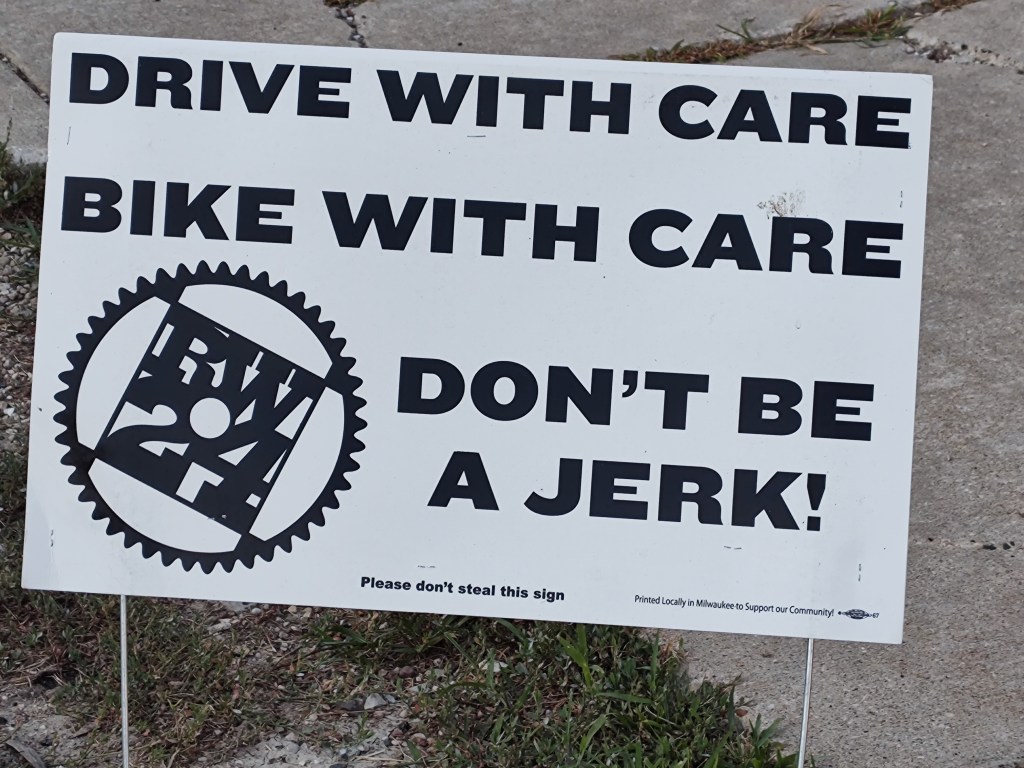
Gradually, riders spread throughout the 4.6 mile course. Speedsters sped. We in the “Elder” category that Molly signed us up for did not.

Instead, we enjoyed high-fiving the little kids lining the residential streets in front of their parents’ homes or shade tents standing curbside. We basked in their cheers and encouragement, laughed at humorous handmade signs, and admired artwork scattered throughout the route.
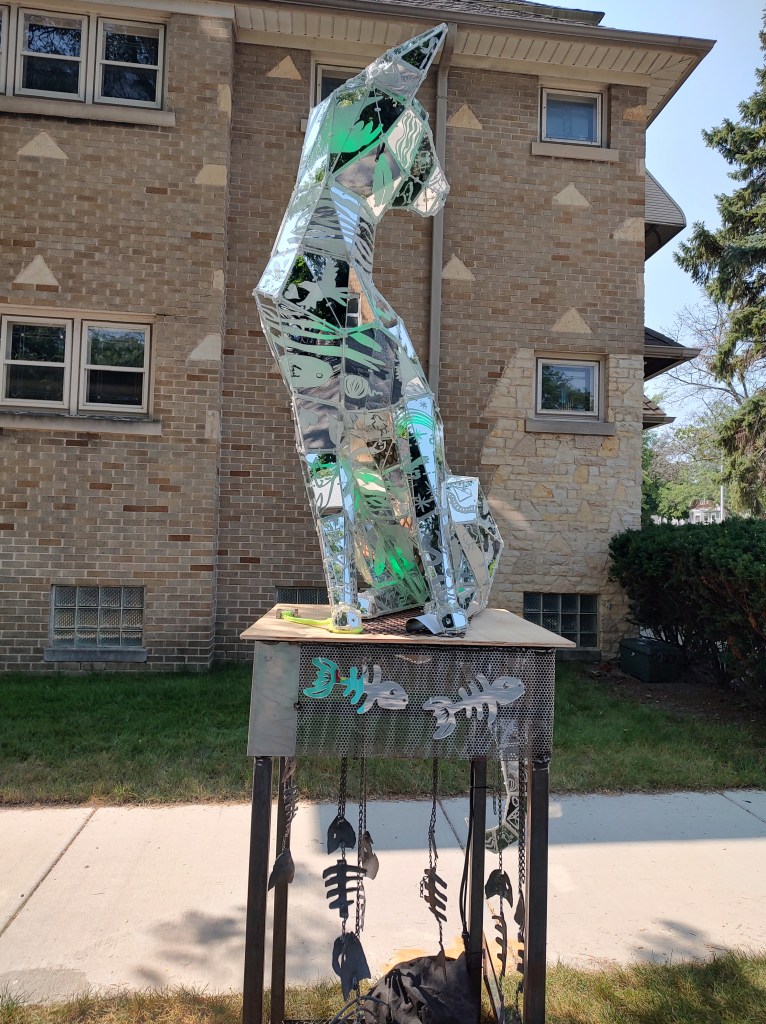
Occasionally, we stopped at “bonus checkpoints” to get our “passports” stamped, earning points in addition to those for each completed course lap.
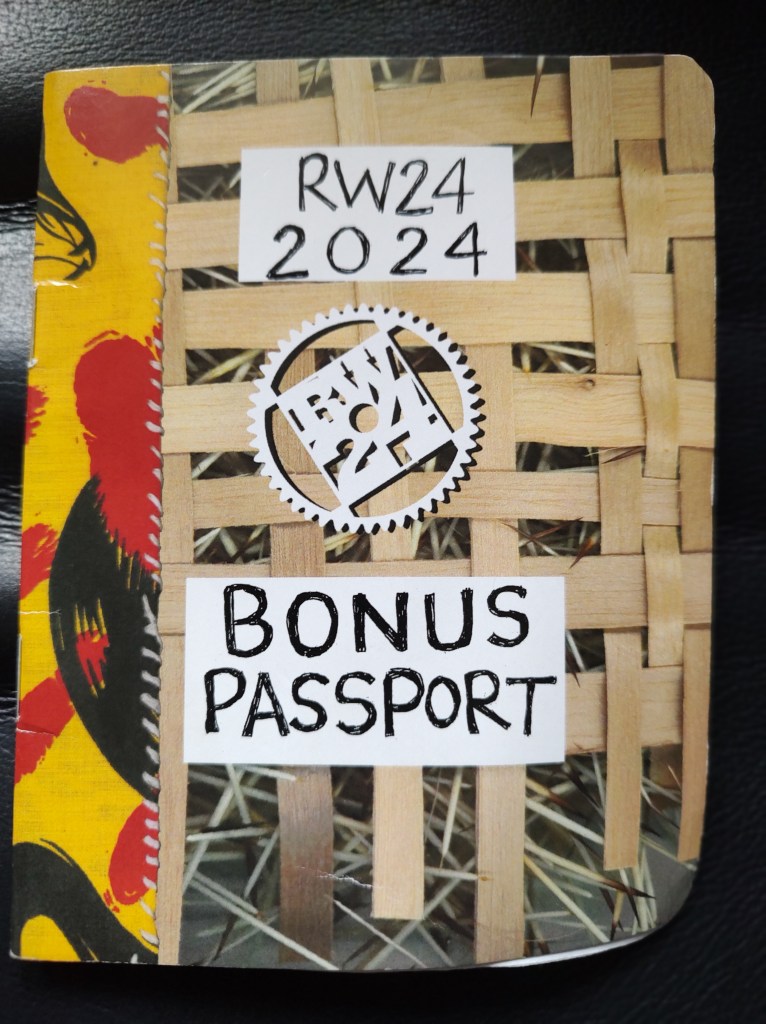
The bonus checkpoints brought us into homes, businesses and parks, where we participated in cleverly named non-cycling activities. For example, “Don’t Pull a Hammy” provided a stretching session inside the cavernous Dropout Fight Club boxing gym, and “Let the Rhythm Move You” at Wu-Tang Park offered a group belly dancing lesson.

From about 9-11 p.m., we took a break from our bikes to watch a street circus from Molly’s balcony.

Then, just Carol and I ventured back out for more laps and checkpoints. The laps led us past pulse-pounding street parties, live bands, DJs, drunken revelry, and all the rest of the eclectic energy that marks the Riverwest community.

My favorite checkpoint was “A Night at the Museum” in the Jazz Gallery Center for the Arts, housed at the old Jazz Gallery performance space, where, as a high school senior, I watched Art Pepper play alto just weeks before he died. While Carol perused the Riverwest 24 memorabilia display, I got lost in the jazz artifacts and a recording of the late great Milwaukee jazz radio DJ Ron Cuzner and was transported back to 1982.

Other checkpoints reflected the quirkiness of the Riverwest community. “What Are You Buying? What Are You selling?” featured a masked and hooded man inside a candle-lit tent on the Beerline bicycle trail, who mutely helped us discern how to complete a transaction for a vial of “potion” that turned out to be an ounce of kombucha. In someone’s basement we threw darts at balloons for a chance to win a container of Cup Noodles ramen. By 2:30 a.m., I needed off the streets with about 23 miles behind me.

I slept from 3-6 a.m. By 7, I was back out on the bike for the day’s first bonus checkpoint. “Poetry Tarot” occurred at Woodland Pattern, an independent bookstore that sells my book Az Der Papa. To get my passport stamped, I sat for a turn of tarot cards with random phrases that I was told to transcribe, edit into a new piece of writing, and read aloud on the mic to whoever was in the street.
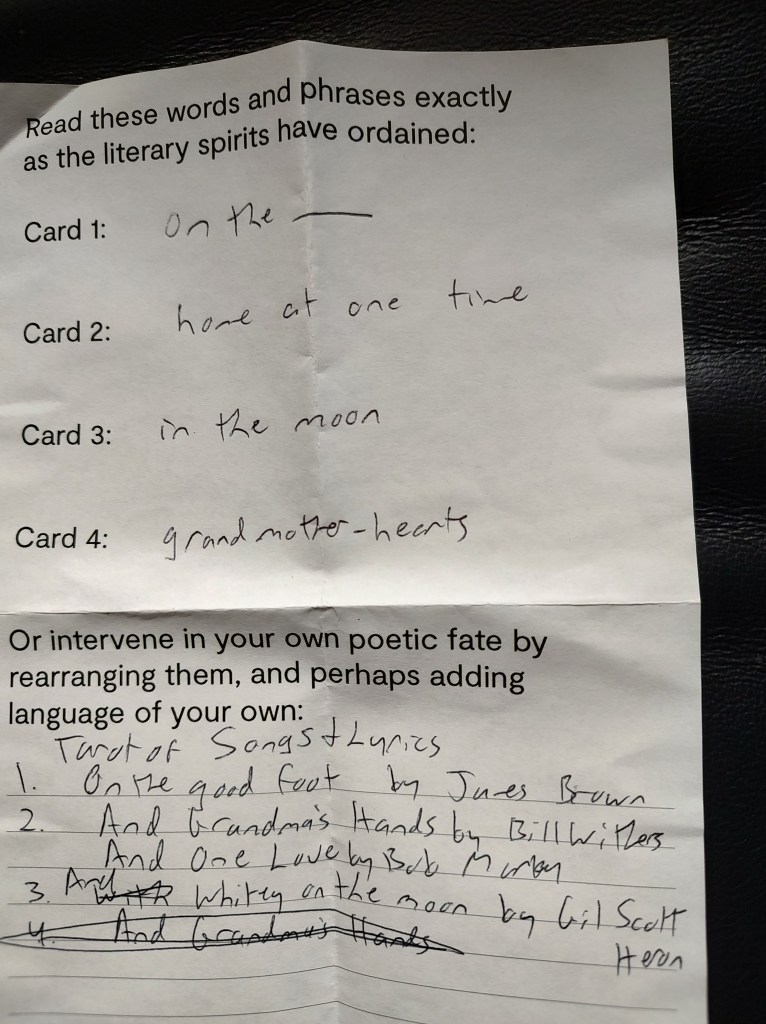
Our Team Millio Zillio group text re-convened us at Woodland Pattern, where we planned a strategy to help our team complete a total of 20 laps before the race ended 12 hours later. Through a comedy of flat tires, needing to meet teammates’ delightful adult children at various checkpoints, and wanting a traditional Milwaukee brunch of Bloody Mary, we rode — sometimes alone and other times together — until an appointed stop at “The Pride of Milwaukee” checkpoint, which opened at noon at Black Husky Brewing.
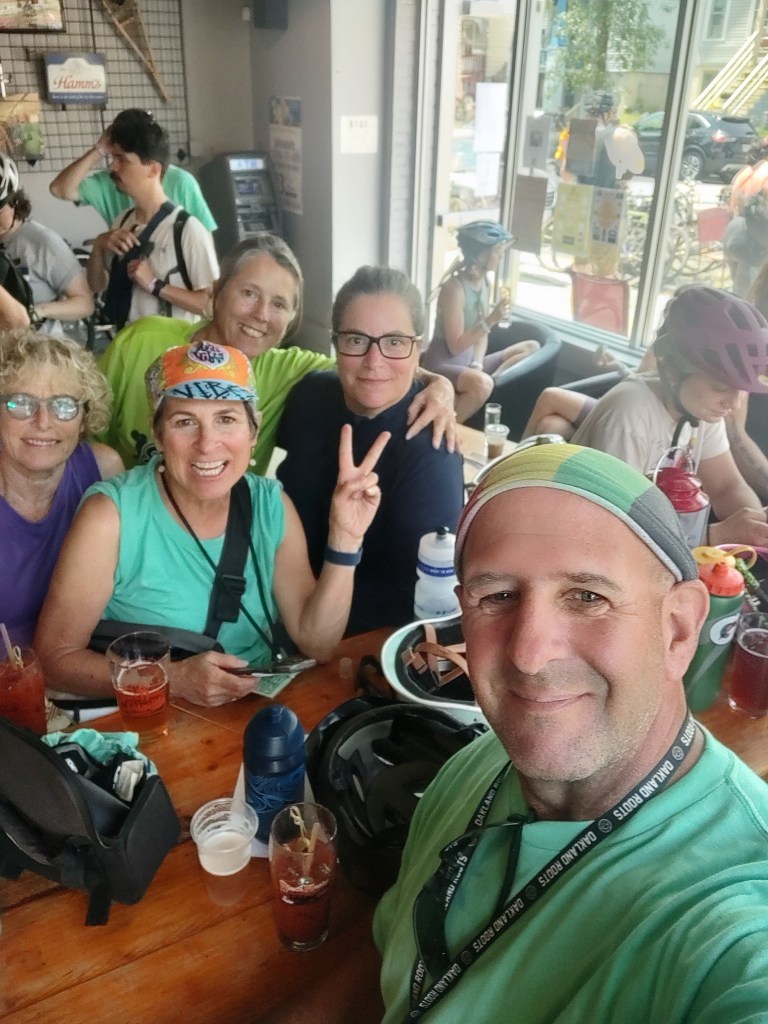
Damn good Bloody Mary served Wisconsin style with a chaser of pilsner brewed onsite and damn fine company as we ran into old high school buddy Mike D’Amato (not pictured).

From there, we ground through laps to get our goal in the 82-degree heat, amid the cacophony of Harleys and Air Force jets, surrounded by swarms of competitive cyclists. We were sleepy and sore, but fueled by free food at one of the checkpoints and soaked in sweet relief by sprinklers and squirt-gun toting curbside kids. The Riverwest community rallied around us and kept us going.

By about 6 p.m., we finished our 20th lap. Riverwest 24 officials at the final checkpoint punched the last hole in the second page of our official race manifest.

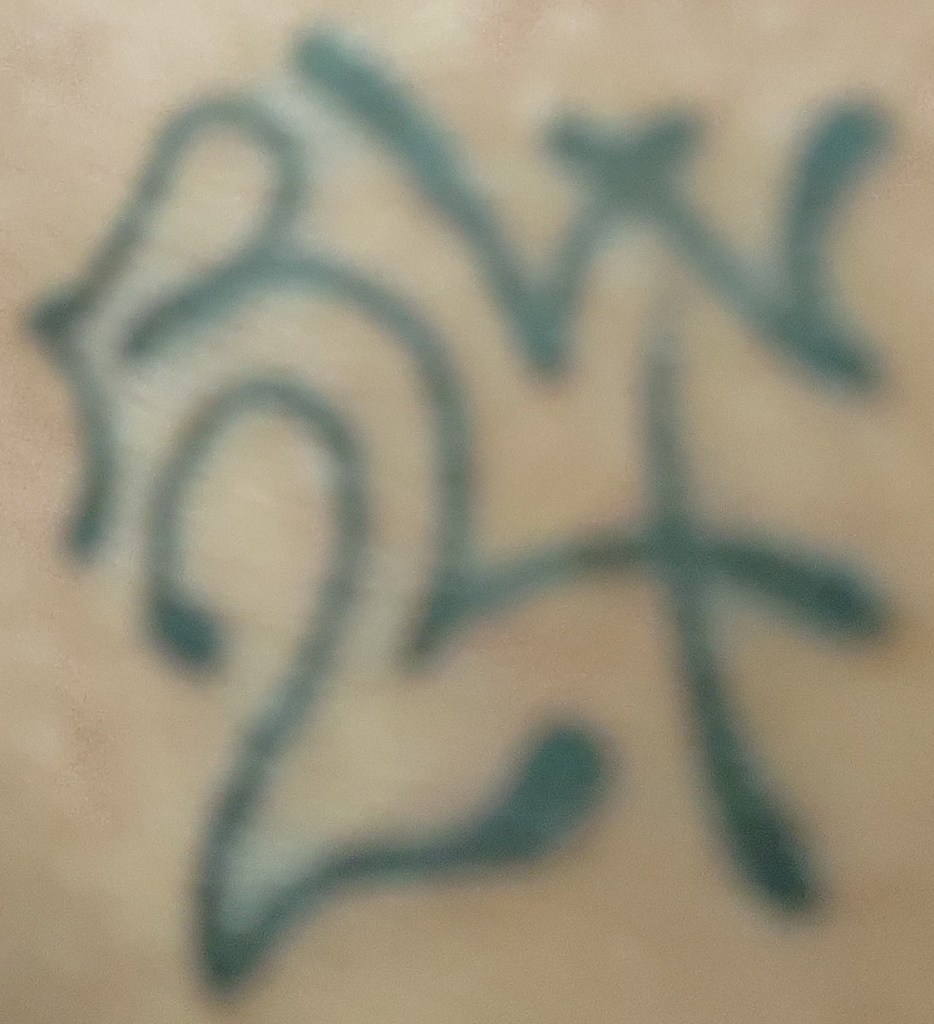
We rode to our 6:30 tattoo appointments at Falcon Bowl, established 1915. We waited at the bar, replenishing our precious bodily fluids and building our courage until it was time to climb the narrow staircase in stifling heat to an office space/tattoo parlor. For about five minutes and with minimal pain, we permanently commemorated our ride, earning the bonus points that put us in a 7th-place tie on the leaderboard among 19 teams in the Elder category.

Our most important business complete, we rode back to the finish line, just as the race officially ended, satisfied with these stats.

We sat on the patio of Club 99, watching people take turns launching their bikes off the ramp at the Cheese Jump.

Over our last beers of the Riverwest 24, we swapped stories of our own adventures and gratitude for the community commitment it took to manage 1,800 riders and untold numbers of spectators, from the top echelon of organizers to each and every volunteer pool noodler who directed traffic over the previous 24 hours, keeping us safe, sane, and supremely satisfied with our experience.

Real Americans

Image

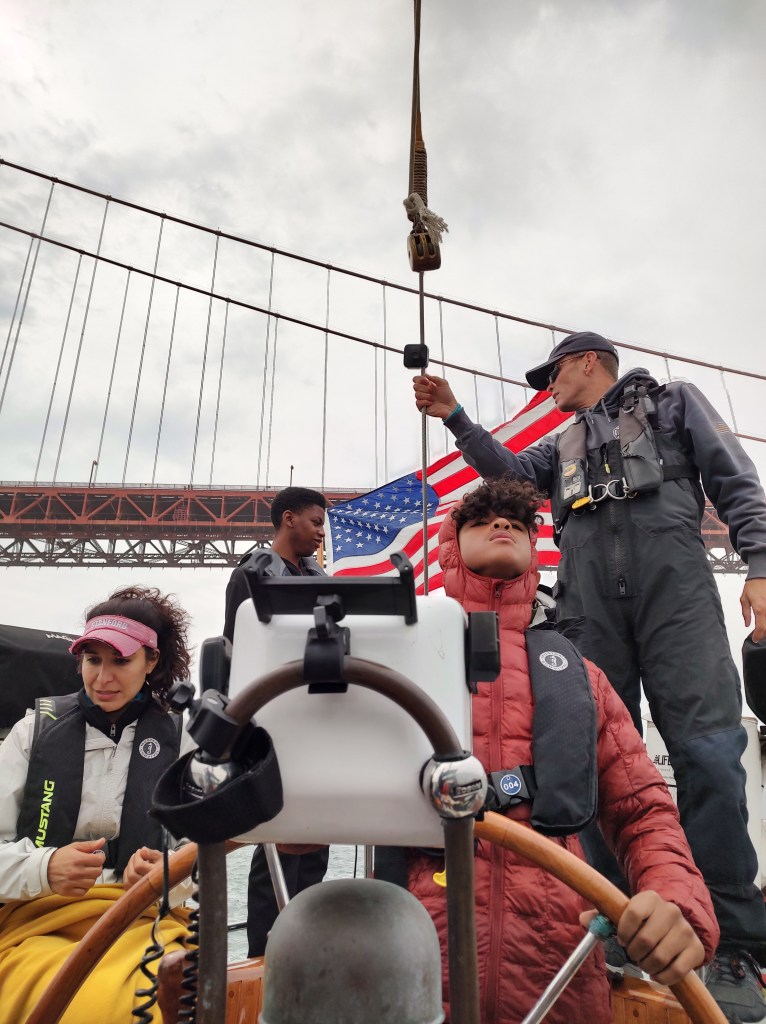
When Eric Jones, captain of Sea Valor, handed me that flag behind us to place in the flag holder yesterday, my first thought was “don’t drop it into the Bay.” The American flag means more to Eric than it does to many of us.

Eric’s story came to me from Tony Green a few weeks ago, as I sat across Tony’s desk at Bishop O’Dowd High School in Oakland learning about his pioneering work with the new AP African-American History course. Tony invited me to join his group aboard Sea Valor, where Eric, Tony’s former student, would contribute to the course curriculum.

An invitation for a day sailing on the Bay is a no-brainer, but that invite grew dear to my heart when Tony told me Eric’s story, adapted here from http://www.SeaValor.org:


Eric grew up in the Bay Area, his mother a social worker, and his father an Air Force Colonel. Eric felt compelled to help people from an early age and became an EMT as soon as he turned 18. That led to him joining the Prince George’s County Fire Department, where he received additional training in firefighting, search and rescue, hazardous materials, and rescue diving. Eric continued by earning his Paramedic certification, and in 1998 graduated from The George Washington University (GWU) with a BS in Health Sciences, with a focus on Emergency Medical Services with a minor in Psychology.

On the morning of September 11, 2001 Eric was driving to class at GWU (he was then working towards a Masters in Public Health), and as he neared the Pentagon, American Airlines flight 77 had just crashed into the Pentagon. Knowing he had the skills to help, he pulled over and ran towards the building. He helped pull and carry five people from the impact zone, and then spent the next four days as a member of the Mortuary Affairs team removing the remains of those killed. On September 14, Eric finally left the Pentagon, and drove to New York Ground Zero, to join fellow members of his fire department who were already there assisting with the massive search and rescue operations. He spent another two weeks engaged in search and rescue, and then search and recovery operations. For his efforts, Eric was one of two people awarded the Medal of Valor from the Department of Defense, the highest civilian award issued for heroism.

Like many of the first responders during 9/11, Eric has struggled with PTSD, and additional traumatic events over the years have made it worse. He has tried all of the traditional treatment methods; therapy, medications, support groups, etc., and found varying degrees of success, however nothing has “cured” the depression and PTSD.

Over the years, Eric has known seven people who have taken their lives as a result of their depression and PTSD. In 2016, his friend Jason, an honorably discharged and highly decorated Army sniper, took his own life. Just a few months later, his friend Andrew Berands, an Oscar-winning cameraman, took his life. Both of these tragic deaths affected Eric very hard. He has known firsthand the deep feelings of hopelessness and despair that result from the inability to process traumatic events. Eric’s fate might have been the same, but believes that sailing and a love for the ocean saved his life.

Eric has always loved all things ocean; scuba diving, swimming, boating, exploring tidepools, but in 2010 he discovered sailing. First, on small sailing dinghies in the Potomac River, then on larger boats which ventured offshore. In 2011 Eric served as crew on his friend’s boat sailing from Miami, Florida to Annapolis, MD. This experience solidified his love for sailing.

For a week, as they cruised up the Eastern Seaboard, Eric felt happy for the first time since before 9/11. His depression was still there, but sailing and being surrounded by the ocean and all of its beauty, brought him a sense of peace that he had been yearning for. This was the first time he realized the healing power of sailing and the sea.

Over the next several years, Eric’s depression grew worse. After his mother died in 2015, followed by the suicides of his two friends, Eric was in a bad emotional state. The only time he felt calm and at peace was when he was near or in the ocean. He started sailing with friends, and over time, he realized that he felt better not only on the days that he sailed, but on the days before and after. Sailing and other ocean activities were helping. Eric founded Sea Valor to bring the same healing to others suffering from PTSD.


Yesterday, I joined Tony, a diverse group of his students, and a few other strays like myself at the Emeryville Marina, where Sea Valor is moored. I asked Tony how Eric might be feeling on the eve of the 21st anniversary of the 9/11 attacks. He said that we may or may not hear from Eric about that, and he reminded me to check out the display below deck of the triangular-folded flag that Eric rescued from his days of service at the Pentagon.

Waiting in the parking lot as Eric and his crew prepared, Tony completed the class’ unit on “The Global Reach of the Mali Empire,” dropping knowledge and calling on students to contribute what they’d learned in his classroom, including the voyage of King Abubakari II, ruler of the Mali Empire, who in 1311 AD, led an African exploration to the New World, sending out 200 ships of men, and 200 ships of trade material, crops, animals, cloth, and African understanding of astronomy, religion and the arts.

Soon after boarding, Eric’s father, a retired Air Force colonel, gave a brief presentation on African-American contributions to our country and gave us each a newly minted quarter commemorating the Tuskegee Airmen. That set the tone for our voyage, mixing education, a celebration of Black excellence, inter-racial exploration, and the co-operation that sailing requires.

Eric put us under engine power until we cleared the Berkeley Pier. Students helped raise and lower sails and took turns at the wheel under direction of Eric and his crew–Heather and Nixon. We tied up at Angel Island, the “Ellis Island of the West,” where many Asian immigrants started their American adventure. There, Eric presented to the students about the technical aspects of currents and navigation, introducing a STEM element to Tony’s teaching and helping students understand what confronted both King Abubakari II and then 300 years later, those who endured the Middle Passage.

From Angel Island, we sailed toward and under the Golden Gate Bridge.

Then we skirted Alcatraz Island, where Tony and our new friend, Wanda, kept conversation real as we drifted past reminders of some other real Americans.

Eric kept us on the water for about five magical hours. Although we never heard from Eric about his trauma, many of us shared stories of our own. Wanda and I compared notes on the Black and Jewish experiences as both friends and foes in this country. Nixon, of Asian descent, explained that his father named him after the former President, dooming him to not only persistent questions about the origin of his name, but also being playground nicknamed “Tricky Dick.”

Exhausted and exhilarated, we arrived back at Emeryville, processing thoughts and feelings that arose from our conversations, none about how to make America great again, most about how to make America America again.

Front Row at the Shitshow

Image

Athletes’ autographs long ago lost their meaning for me. But authors’ autographs still have value, as though the signature itself, and perhaps a personal note based on a moment’s discussion, affirms my connection to the writer’s work.

“There There” by Tommy Orange is such a work. You’ll never read anything else like the brilliant, brutal 10-page prologue, which alone stands as capital L Literature, crashing the canon with its naked depiction of all that has befallen Native Americans.

The San Francisco Public Library named “There There” its One City One Book selection for 2019. The library’s website says, “One City One Book: San Francisco Reads is an annual citywide literary event that encourages members of the San Francisco community to read the same book at the same time and then discuss it in book groups and at events throughout the City. By building bridges between communities and generations through the reading and, most importantly, the discussion of one book, we hope to help to make reading a lifelong pursuit and to build a more literate society.”

I couldn’t wait to discuss this book with Tommy Orange. He so thoroughly inhabited all dozen or so of his chapter-named protagonists that the chance to ask him how he did it could supplant a lifetime of learning how to write.

Held in conjunction with Litquake, the event was scheduled for the library’s main branch on Wednesday, October 16 at 6 p.m. Given the mass public’s appreciation for literature and concern with the Native American plight, plus the sidewalks near the library being littered with needles and human feces, I figured I could show up and get my book signed at 5:59.

But all seats were filled, and so were the aisles until the ushers said we could sit on the floor at the foot of the stage. After some pomp and circumstance, the MC introduced San Francisco Poet Laureate Kim Shuck, herself a Cherokee citizen, “in conversation with Tommy Orange.”

Minutes later, it was apparent that this event was no book group writ large. Between long silences and Kim wondering aloud what to talk about, it was an awkward, meandering non-conversation, covering such topics as their discomfort on-stage.

An audience member raised her hand and was called upon. She rose from her seat to suggest they discuss the book. “That’s some privilege,” said a voice from over my shoulder.

Tommy Orange asked her what she wanted to know. She mentioned that the book’s prologue was hard to read and wondered why he chose to write it that way. His head collapsed into his open palm.

Someone else asked if he could repeat the question. “No,” he answered. “We don’t need to repeat the question. Her privilege is showing, and she just needs to cover it up.”

The woman who asked the question and some others who looked like her left the building. While we waited for what was next, another woman raised her hand and was called on. She chastised the author, saying he had “shat” on the first woman. Tommy Orange asked for a moment of silence in memory of those women’s shattered beliefs and “Please, no more white hands raised.”

A few more people walked out. I felt criminal for being white, which kept me mindful of how everyone red — or yellow or black or brown — had suffered so much more for their skin. I genuinely wanted to discuss the book, but if Tommy Orange did not, that was his privilege, and of course it should not be my privilege to determine his privilege. That was part of the point of his book.

For another forgettable hour, the authors muddled through until the MC mercifully called time. I learned little of what I’d hoped to know, but I thought a lot. I thanked Tommy Orange for that from my seat in the front row of the shitshow, and I asked him not what I wanted to know but simply to sign his book.